Electric fencing · Installation
Electric fence installation near me: planned, built and signed off
Looking for electric fence installation near you? We plan and install new electric fences across Johannesburg, the East Rand and Centurion, on boundary walls and as freestanding fences, and hand every one over with its certificate. 2-year warranty and a compliance certificate on every new electric fence we install. Here's how a fence is planned, what the rules require, how the job runs and what a new fence typically costs.
2-year warranty and a compliance certificate on every new electric fence we install
Six-month guarantee on our repairs
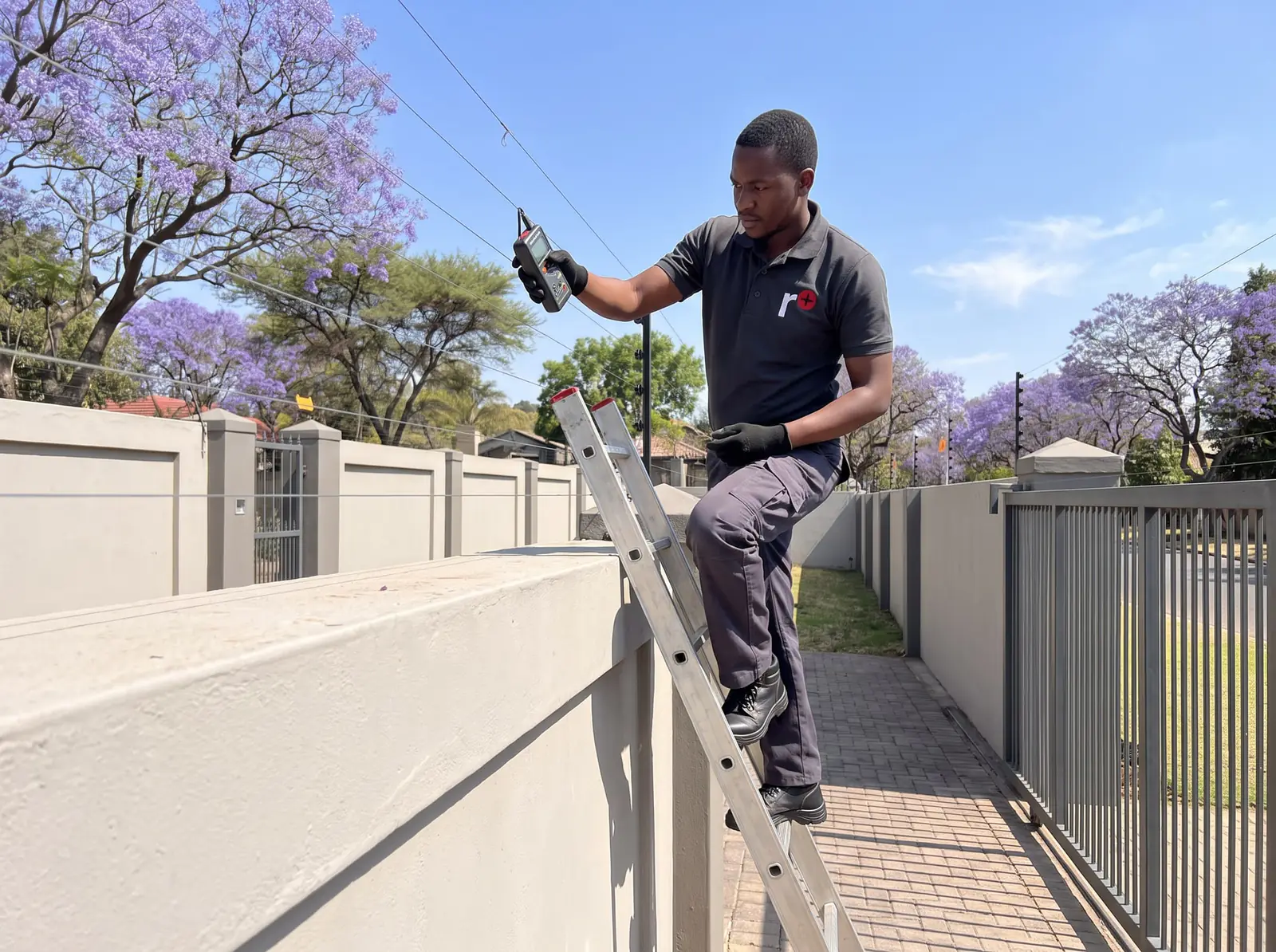
Wall-top or freestanding?
- Wall-top. Brackets fixed along the top of a boundary wall carry the live lines, between six and twelve in the price lists below. It's what most homes have, because the wall already does the job of a barrier.
- Freestanding. The fence stands on its own posts with many more lines, 18 to 30 in the same lists, for open boundaries, smallholdings and business premises.
- On top of another fence. An electric section can run along the top of a palisade or weld-mesh fence, kept electrically separate from the steel, which is earthed.
More lines cost more per metre but are harder to climb through, and a freestanding fence costs more per metre than a wall-top one, as the prices below show. The choice comes down to the boundary you have, how exposed it is, and whether the fence has to stand alone.
Zones, energisers and alarms
The energiser powers the fence and watches it: when a wire is cut, shorted or earthed, it sounds the alarm. Planning it means three choices:
- How many zones. A short suburban wall can run as one zone. A long boundary is split into two or more, so an alarm tells you which stretch to check; energisers come in single- and multi-zone models.
- Which energiser. We fit Nemtek and JVA energisers, sized to the fence's length and number of zones. Our energiser page compares them.
- What it connects to. A siren and strobe light on site, a keypad by the door to arm and disarm it, magnetic switches on the gates, and the alarm panel, so your armed response company sees a fence alarm. Nemtek's installer notes say the alarm panel connects through an isolation relay, and never runs from the energiser's own battery.
The energiser has its own back-up battery, so the fence stays live and monitored through a power cut. It needs a plug point close by; a new point is a job for a registered electrician.
What the rules require
Electric security fences are built to the standards that Nemtek's and JVA's installation manuals cite and summarise: SANS 10222-3 for the fence in South Africa, IEC 60335-2-76 for the energiser, and, in JVA's manual, SABS 1063 and 0142 too. In plain terms:
- Warning signs at every gate and access point and at least every 10 m, readable from both sides, with at least one on each side of the fence. Each is at least 100 × 200 mm, yellow on both sides, with black lettering at least 25 mm high saying the substance of "CAUTION: Electric fence".
- No barbed or razor wire electrified, or fixed close to the electric lines: it can trap a person or an animal.
- One energiser per fence. Two fences on different energisers stay at least 2.5 m apart, unless a barrier separates them.
- Gates must open without the person opening them getting a shock.
- Earthing. The fence's earth electrode sits at least 10 m from any other earth system, and where a fence passes under bare power lines, its metal is earthed for at least 5 m either side.
- Cabling. The high-voltage leads run in their own conduit, never alongside mains or alarm wiring, insulated indoors and in insulating conduit underground.
Certified electric fence installer. A fence we build is checked against these rules before we hand it over with the certificate, and if you're selling, buying or adding to a fence, electric fence certificates explains the inspection.
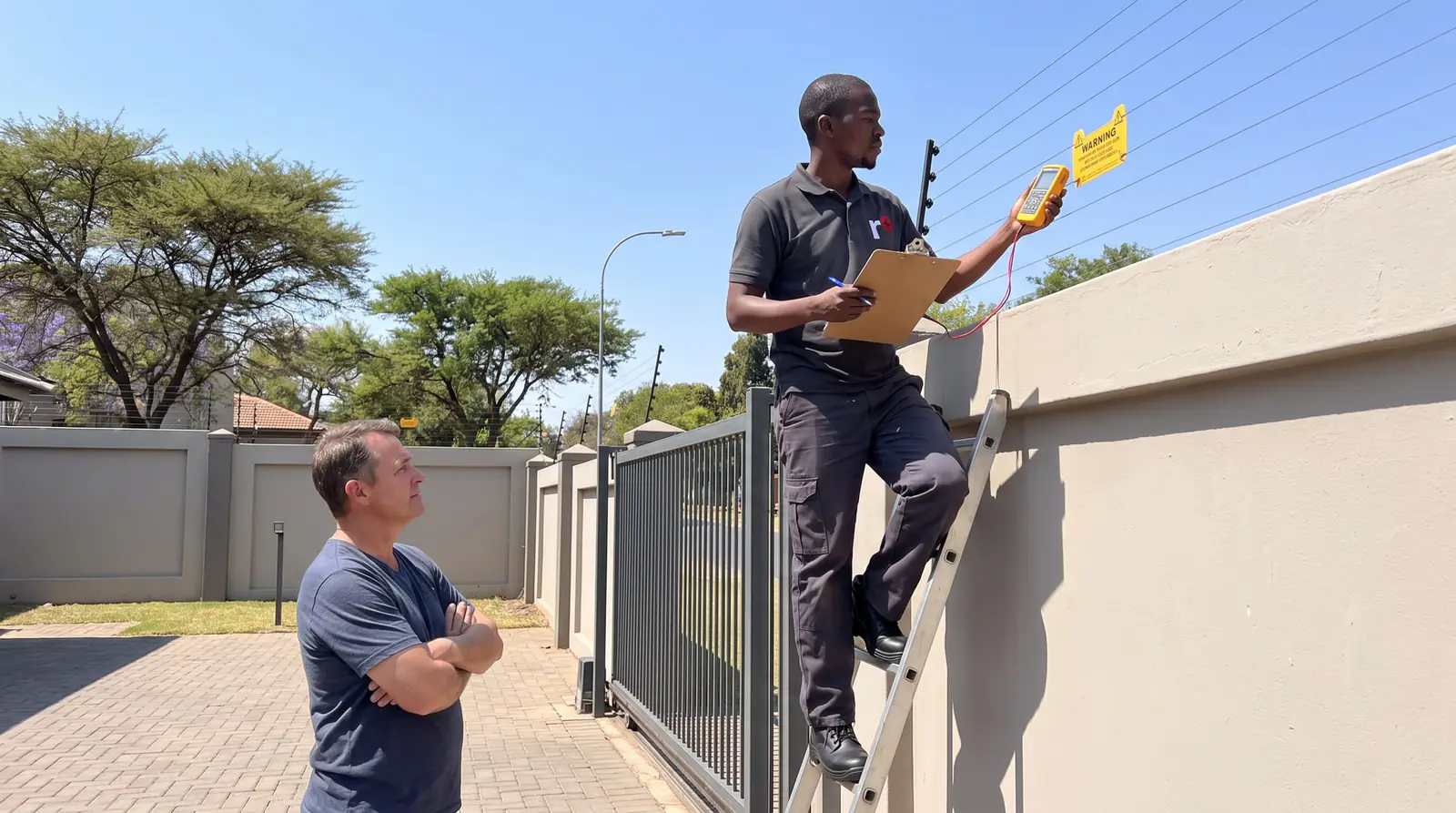
How an installation runs
- Site visit. We walk the boundary with you: its length and height, the state of the wall, the gates, any neighbour's electric fence nearby, where the energiser and its plug point will go, and where the earth spikes can be driven in.
- Quote. The design, the number of lines and zones, the energiser and the extras, priced in writing before any work starts.
- Brackets and insulators along the wall or posts, at an even spacing.
- Wire. Strung, tensioned and joined only with ferrules or line clamps; Nemtek's installer notes warn against mixing metals, such as copper on steel, at a joint.
- Energiser, battery and earth. The energiser goes somewhere dry and ventilated, with its earth spikes close by and at least 10 m from any other earth system, and high-voltage cable to the fence.
- Gates, keypad and alarm. Magnetic gate switches, the keypad, the siren and strobe, and the link to your alarm panel.
- Signs and testing. Warning signs go up, and the alarm is tested with a short and a break at the furthest point of each zone, as Nemtek's notes ask.
- Certificate and handover. You get the certificate and a walk-through: arming and disarming, the keypad codes, and what each alarm means.
What a new fence typically costs
Typical market prices for a new fence, installed, in Gauteng. They're not our prices, which are set in a quote after the site visit.
| Fence | Typical price |
|---|---|
| 6-line wall-top | R95–R115 a metre |
| 8-line wall-top | R115–R125 a metre |
| 10-line wall-top | R130–R145 a metre |
| 12-line wall-top | R145–R165 a metre |
| 18-line freestanding | R205–R225 a metre |
| 24-line freestanding | R275–R295 a metre |
| 30-line freestanding | R350–R400 a metre |
Cost guides agree: R95–R220 a metre (Kandua) installed in Johannesburg, and for a typical suburban home with 50 to 100 m of wall-top fence and its certificate, R12 000–R25 000 (Kandua). Short runs cost more per metre: R300–R400 a metre (ProCompare) all in. The energiser is the biggest single item: a Nemtek Druid 13 LCD is about R2 940–R3 280 (Takealot, NeonSales) in shops and a two-zone Nemtek Druid 25 LCD (2 zone) about R6 230 (NeonSales), with a 12 V 7 Ah battery R230–R450 (Takealot).
Prices checked October 2026. Your exact price is set in a free quote before any work starts. No call-out fee when we do the work. If no work is done, a R650 call-out fee applies.
Extending or upgrading an old fence
Not every job starts from bare wall. We add lines to a low fence, extend a fence along a new wall, split a long single-zone fence into zones so faults are quicker to find, replace a tired energiser with a newer one, and add a keypad, gate switches or the link to an alarm panel. Adding to or altering a fence brings in a new certificate, so an extended fence is inspected again. A fence that keeps alarming may only need a repair: start with electric fence repairs.
Areas
Electric fence installation near you
- Electric fencing · Alberton
- Electric fencing · Bedfordview
- Electric fencing · Benoni
- Electric fencing · Bryanston
- Electric fencing · Centurion
- Electric fencing · Douglasdale
- Electric fencing · East Rand
- Electric fencing · Edenvale
- Electric fencing · Fourways
- Electric fencing · Hyde Park
- Electric fencing · Inanda
- Electric fencing · Johannesburg
- Electric fencing · Kyalami
- Electric fencing · Melrose Arch
- Electric fencing · Midrand
- Electric fencing · Morningside
- Electric fencing · Randburg
- Electric fencing · Roodepoort
- Electric fencing · Rosebank
- Electric fencing · Sandton
- Electric fencing · Saxonworld
Questions
Electric fence installation questions
How much does it cost to install an electric fence in South Africa?
It depends on the length of the fence, the number of lines and the energiser. Cost guides put a typical suburban home, with 50 to 100 m of wall-top fence and the certificate, at R12 000–R25 000 (prices checked October 2026). See the price table.
How much does it cost per meter to install an electric fence in South Africa?
Installer price lists in Gauteng put a 6-line wall-top fence at R95–R115 a metre and a 30-line freestanding one at R350–R400 a metre; more lines and taller posts cost more. Prices checked October 2026. Compare every line count.
What are the legal requirements for installing an electric fence in South Africa?
The fence must follow the standards for electric security fences: yellow warning signs at gates, access points and every 10 m, no electrified barbed or razor wire, one energiser per fence, gates that open without a shock, and correct earthing. A new or altered fence needs an Electric Fence System Certificate from a registered installer. Read the rules.
How do you install an electric fence?
After a site visit and quote, brackets and insulators go along the wall or posts, the wire is strung, tensioned and clamped, then the energiser, battery, earth spikes, gate switches and keypad are connected. Warning signs go up, every zone is tested, and the fence gets its certificate. See every step.
What is the average cost of installing an electric fence?
For a home with a 100 m perimeter, installer price lists put a complete fence at R14 500–R25 000; the energiser, the number of lines and the state of the wall move it either way (prices checked October 2026). Ours is quoted after a site visit. See typical prices.
Book a technician
Get an electric fence quote
Job card
We WhatsApp or call you back. Fields marked (required) are needed.