Palisade and weld mesh
Steel palisade fencing and gates
A boundary you can see through but not climb over: we supply and install steel palisade and mesh fencing for homes, complexes and businesses across Johannesburg, the East Rand and Centurion, with driveway and pedestrian gates ready for a motor, and repair fences that have been hit, bent or rusted.
Six-month guarantee on our repairs
What steel palisade fencing is
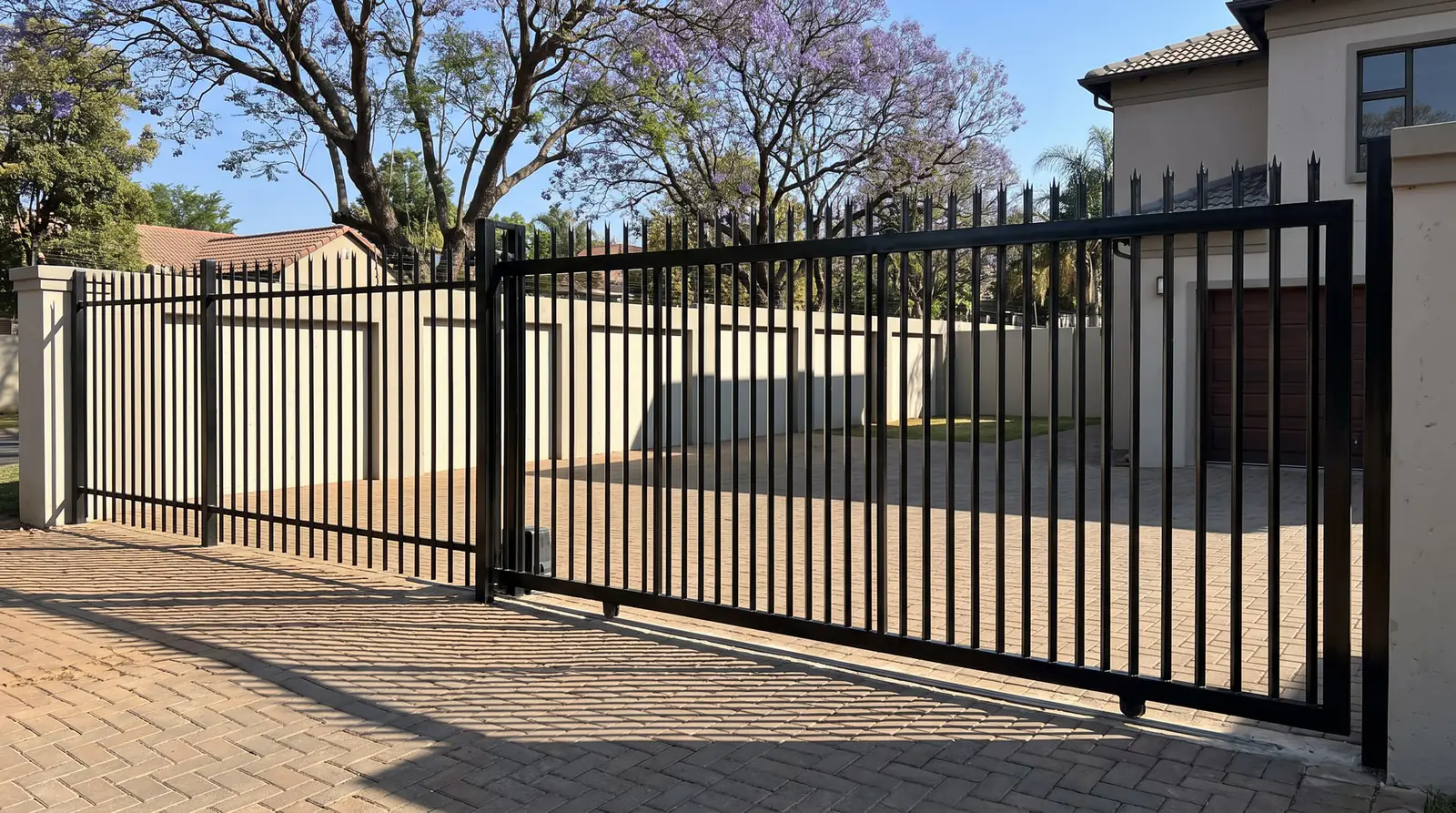
Palisade is a fence of vertical steel pales, each pointed at the top, bolted to horizontal rails that run between steel posts set in concrete. The pales are pressed into a D or W profile, which makes them stiff for their weight and hard to bend apart, and the gaps between them keep the boundary see-through, so passers-by and patrols can see in and nobody can hide behind it.
It comes galvanised, painted or both, in heights from about 1.2 m for a front garden to 2.4 m and more for a business or a high-security boundary. Along a street front it's often set between brick pillars; on long runs it stands on its own posts.
We supply and install palisade for houses, townhouse complexes, schools, churches and business premises, with gates to match.
Palisade, weld mesh or ClearVu-type mesh
Three kinds of steel fence cover almost every boundary we're asked about:
- Palisade is the strongest and most visible deterrent. It suits street fronts, businesses and anywhere a vehicle might be driven at the fence.
- Weld mesh is a grid of welded steel wire in panels or rolls. It's lighter and less expensive, and suits garden boundaries, sports fields and complexes that want a softer look: see weld mesh fencing.
- ClearVu-type high-security mesh has openings too small for fingers or tools, so it's very hard to climb or cut, while staying almost transparent from a distance.
The choice comes down to what the fence has to stop, how it should look from the street, and the budget. Our comparison guide sets them side by side.
Heights, tops and finishes
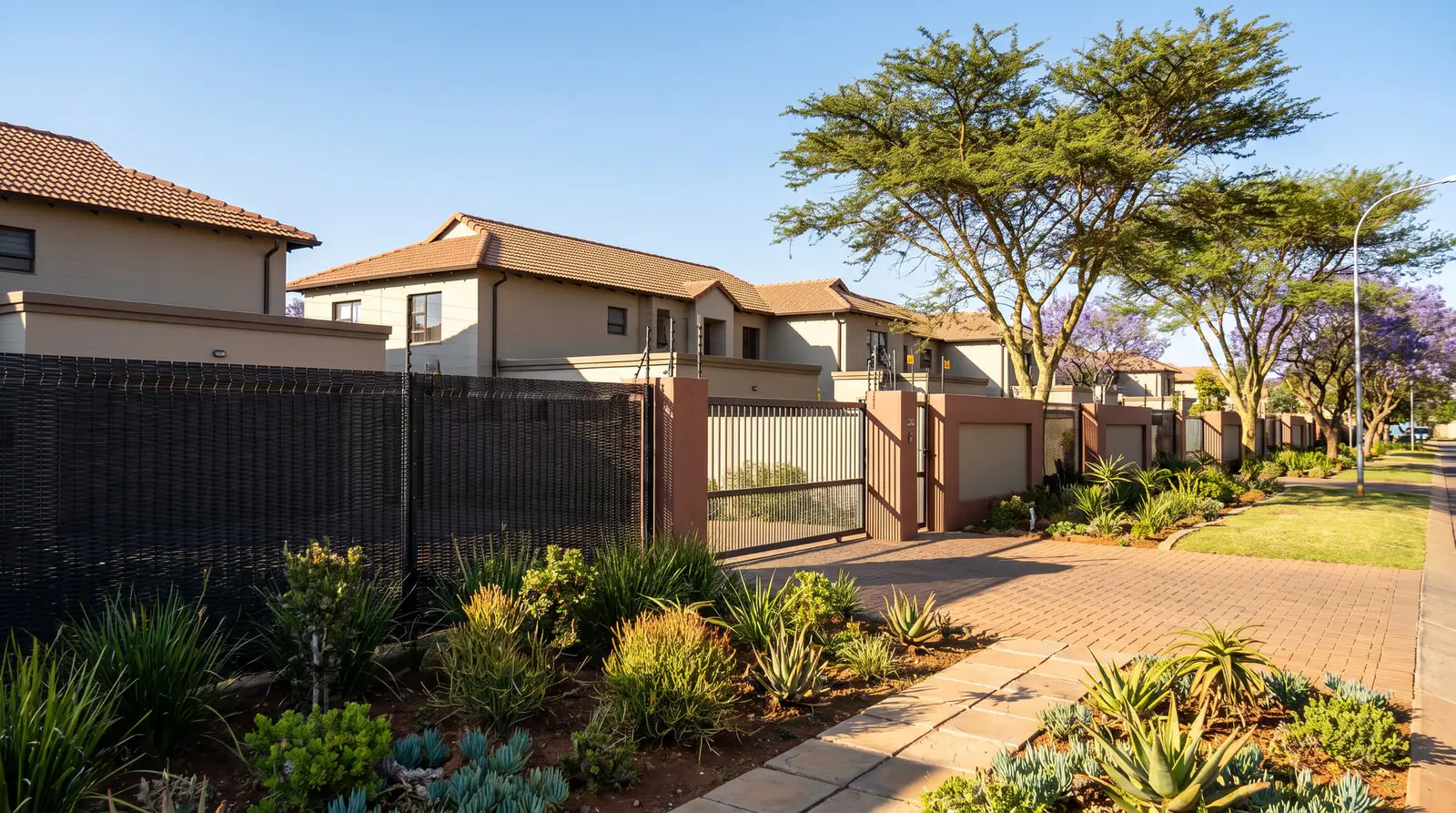
Height is the first decision. A low fence marks a boundary and keeps pets in; a fence at head height and above is about keeping people out, and that's where most security fencing sits. Very high fences around businesses and substations are a different job again, with deeper footings and heavier posts.
The tops of the pales matter too: single, triple or curved-over points make a fence harder to climb, and a fence can be topped with electric strands or razor wire where that's needed and allowed.
For the finish, galvanising protects the steel from the inside out and lasts longest; paint or powder coating adds the colour, usually black, charcoal or green. A painted fence that isn't galvanised will need repainting as it ages, especially at ground level and where sprinklers reach it.
Gates in a palisade fence
A palisade boundary usually needs a driveway gate and a pedestrian gate, made in the same profile so the fence reads as one. Driveway gates can slide or swing, and both can be automated: a sliding gate on a rail with a motor and rack, a swing gate with arms on the posts. Building the gate with the motor in mind, with a straight bottom rail for the rack and room beside it for the motor, saves work later.
We hang the gates and install the motors, so the gate and its automation are one job: see gate motors and sliding gates. A pedestrian gate typically costs R2 500–R6 000 (Completo) on its own in the market (prices checked October 2026).
Adding an electric fence to palisade
Palisade and an electric fence work well together: brackets bolted to the top of the posts carry live strands above the pales, so anyone climbing meets the electric fence at the top. It also suits an existing palisade fence that needs more security, without replacing it.
The electric side is fitted like any electric fence, with its own energiser, earth system and warning signs, and gets its certificate on completion. If you're looking for electric fence installers for a new or existing palisade fence, we do both parts: see electric fence installation and electric fencing.
How we install a palisade fence
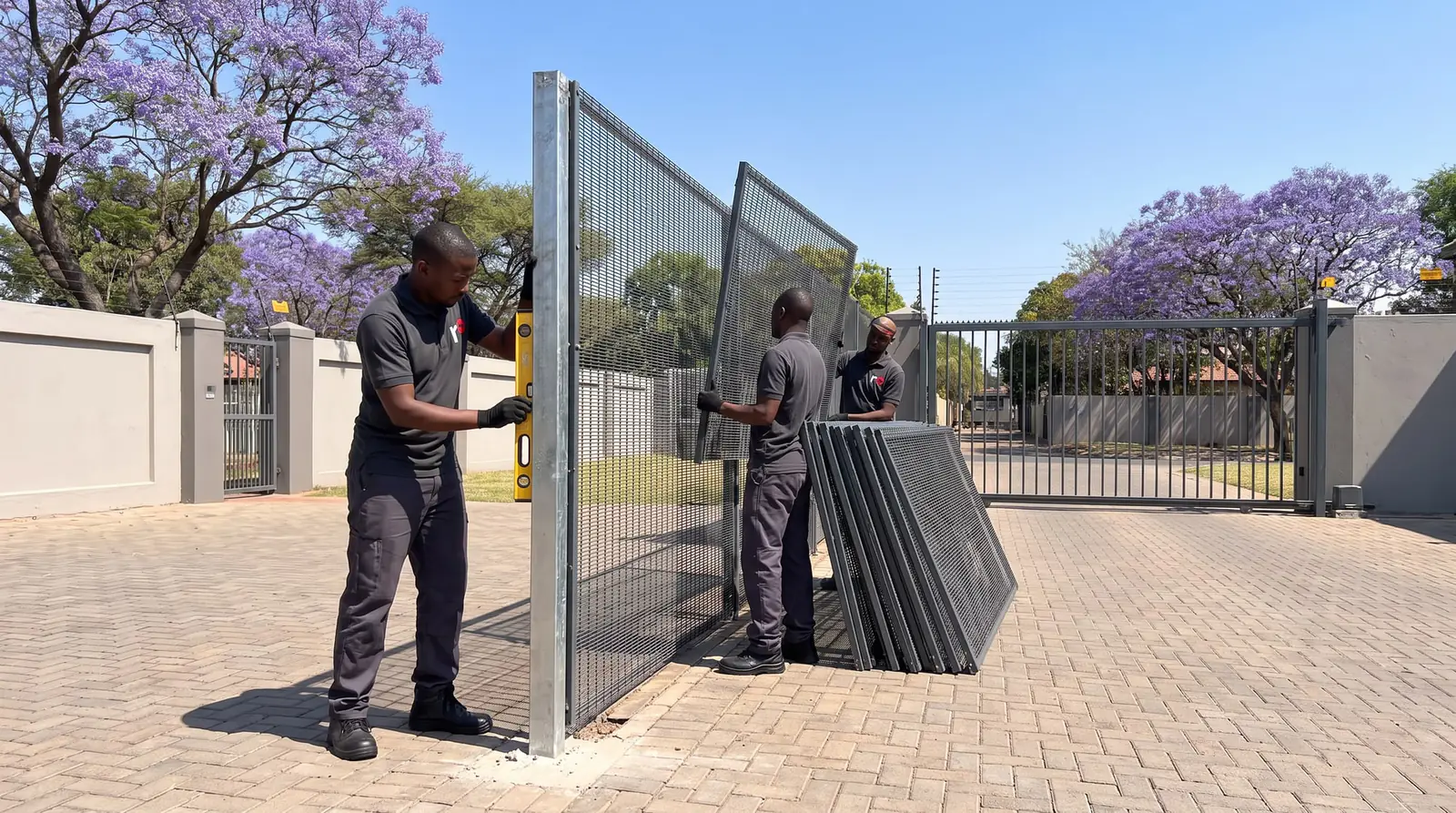
- Measure and mark the line of the boundary, and note slopes, pillars, gates and anything underground.
- Set the posts in concrete at the spacing the panels need, and let the concrete cure.
- Fix the rails to the posts, following the ground on a slope or stepping down with it.
- Bolt the pales on, evenly spaced, and hang the gates.
- Finish: touch up any cut or drilled steel, check the gates swing or slide freely, and clean up the site.
Much of the time on site is waiting for concrete to cure. Where the fence follows a property line, the line should be confirmed first: a fence built a little too far over is an expensive mistake.
Complexes, schools and businesses
Long boundaries change the job. A townhouse complex or an office park usually wants palisade on the street front and at the entrance, with weld mesh or ClearVu-type mesh along the sides and back where it's less exposed, which keeps the total down without weakening the front. Schools and sports grounds often need higher fences with gates sized for both vehicles and crowds.
At an entrance, the fence, the vehicle and pedestrian gates, the gate motors, the safety beams and the intercom or keypad are best planned together. Because we install all of them, the gate posts, the motor bases and the cable runs go in once, in the right place.
Before you fence
A few questions settle most of the design before anyone takes a measurement:
- what the fence must stop: people, vehicles, pets, or simply mark the boundary
- whether it needs to be see-through from the street
- where the driveway and pedestrian gates go, and whether they'll be automated now or later
- whether an electric fence will go on top, now or later, so the posts can take the brackets
- where the boundary line is, on a slope, and against which neighbours
Tell us the answers when you book, with the rough length of the boundary and a few photos, and the quote can be close to the final figure from the start.
Repairs to palisade and mesh
A palisade fence lasts a long time, but it does get damaged: a car reversing into it, a pale cut out by someone getting in, rust at the base where water collects, bolts that have worked loose or been stolen, and gates that drag after a hinge or wheel wears. Weld mesh panels get bent and their clips go missing.
We replace damaged pales and panels, straighten or replace posts, treat and repaint rust, and repair gates, so a fence doesn't have to be replaced because one section has failed.
What palisade fencing typically costs
What it typically costs in Gauteng, supplied and installed, from published cost guides. Prices checked October 2026.
- steel palisade, all heights: R1 100–R2 400 a metre (ProCompare); R1 200–R2 500 a metre (Completo)
- 1.2 m palisade: R900–R1 500 a metre (Kandua)
- 1.8 m palisade: R1 800–R2 200 a metre (Kandua); R1 980–R2 420 a metre (LocalPros)
- 2.4 m palisade: R2 000–R3 000 a metre (Kandua)
- weld mesh: R600–R800 a metre (ProCompare)
- ClearVu-type high-security mesh: R1 300–R1 600 a metre (ProCompare); R1 200–R1 700 a metre (Completo)
- labour only, palisade: R250–R700 a metre (Kandua)
Gates, pillars, slopes and access all change the total. These are market prices, not ours. Your exact price is set in a free quote before any work starts. No call-out fee when we do the work. If no work is done, a R650 call-out fee applies.
Areas
Palisade fencing near you
- Palisade fencing · Alberton
- Palisade fencing · Bedfordview
- Palisade fencing · Benoni
- Palisade fencing · Bryanston
- Palisade fencing · Centurion
- Palisade fencing · Douglasdale
- Palisade fencing · East Rand
- Palisade fencing · Edenvale
- Palisade fencing · Fourways
- Palisade fencing · Hyde Park
- Palisade fencing · Inanda
- Palisade fencing · Johannesburg
- Palisade fencing · Kyalami
- Palisade fencing · Melrose Arch
- Palisade fencing · Midrand
- Palisade fencing · Morningside
- Palisade fencing · Randburg
- Palisade fencing · Roodepoort
- Palisade fencing · Rosebank
- Palisade fencing · Sandton
- Palisade fencing · Saxonworld
Questions
Palisade fencing questions
What is palisade fencing?
Palisade fencing is a security fence of vertical steel pales with pointed tops, bolted to horizontal rails between steel posts set in concrete. It's strong, hard to climb and see-through, which is why it's so common on street fronts and business boundaries. Read what steel palisade fencing is.
Who are the manufacturers of palisade fencing in South Africa?
Palisade is made by steel fabricators and fencing manufacturers around the country, to a few standard profiles, so pales and rails from different makers look much the same. What matters more than the maker is the steel thickness, the galvanising and how well the fence is installed. We supply and install it, so you deal with one company for the fence, the gates and the motor. Get a quote for a palisade fence.
How much does it cost to install palisade fencing?
Supplied and installed, steel palisade typically costs R1 100–R2 400 a metre (ProCompare); R1 200–R2 500 a metre (Completo) in Gauteng, depending on height, finish and the ground (prices checked October 2026). Labour alone is R250–R700 a metre (Kandua). See prices by height.
How much is palisade fencing per meter?
By height, typically R900–R1 500 a metre (Kandua) for 1.2 m, R1 800–R2 200 a metre (Kandua) for 1.8 m and R2 000–R3 000 a metre (Kandua) for 2.4 m, supplied and installed (prices checked October 2026). With brick pillars it rises to R3 100–R3 800 a metre (ProCompare). Compare the fence types.
Is palisade fencing expensive?
It costs more than weld mesh, which typically runs R600–R800 a metre (ProCompare), and is in the same range as ClearVu-type mesh (prices checked October 2026). For its strength and long life it's usually the choice for street fronts, with mesh on the less exposed sides keeping the total down. See what palisade fencing typically costs.
What are the key differences between palisade and garrison fencing?
Garrison fencing is a lighter, more decorative steel fence of square or round vertical bars between rails, often with spear tops, chosen for how it looks. Palisade uses heavier pressed D- or W-section pales bolted to rails, and is chosen for strength and security. Garrison suits a front garden; palisade suits a boundary that has to stop people. Read about palisade, mesh and ClearVu-type fences.
How to install palisade fencing?
Mark the line, set the posts in concrete at the right spacing and let it cure, fix the rails, bolt on the pales, then hang and adjust the gates. Getting the posts plumb and the line straight is most of the skill, and the boundary should be confirmed before anything is dug. See how we install a palisade fence.
Is palisade or weld mesh fencing better?
Palisade is stronger and a better deterrent on a street front or a business boundary; weld mesh is lighter, less expensive and softer to look at, which suits gardens, sports fields and inner boundaries. Many properties use both. Compare palisade, weld mesh and ClearVu-type mesh.
Can you add an electric fence to a palisade fence?
Yes. Brackets on top of the palisade posts carry the live strands above the pales, and the electric fence is installed, earthed and given its certificate like any other. It's a common way to add security to an existing palisade fence. Read about adding an electric fence.
Can you automate a palisade gate?
Yes, a palisade driveway gate can take a sliding or swing gate motor like any steel gate, as long as it runs freely and is built to carry the motor's rack or arms. Planning the motor when the gate is made saves rework. Read about gates in a palisade fence.
Book a technician
Get a palisade fencing quote
Job card
We WhatsApp or call you back. Fields marked (required) are needed.