Palisade and weld mesh · Weld mesh
Weld mesh fencing: rolls, panels and anti-climb mesh, installed
Weld mesh fencing is the lighter, more open alternative to palisade: a grid of steel wire, welded wherever two wires cross, fixed to steel posts. We supply and install it across Johannesburg, the East Rand and Centurion, in rolls for long garden and field boundaries and in rigid panels for complexes, schools and business premises, with gates to match and electric strands on top where they're wanted.
Six-month guarantee on our repairs
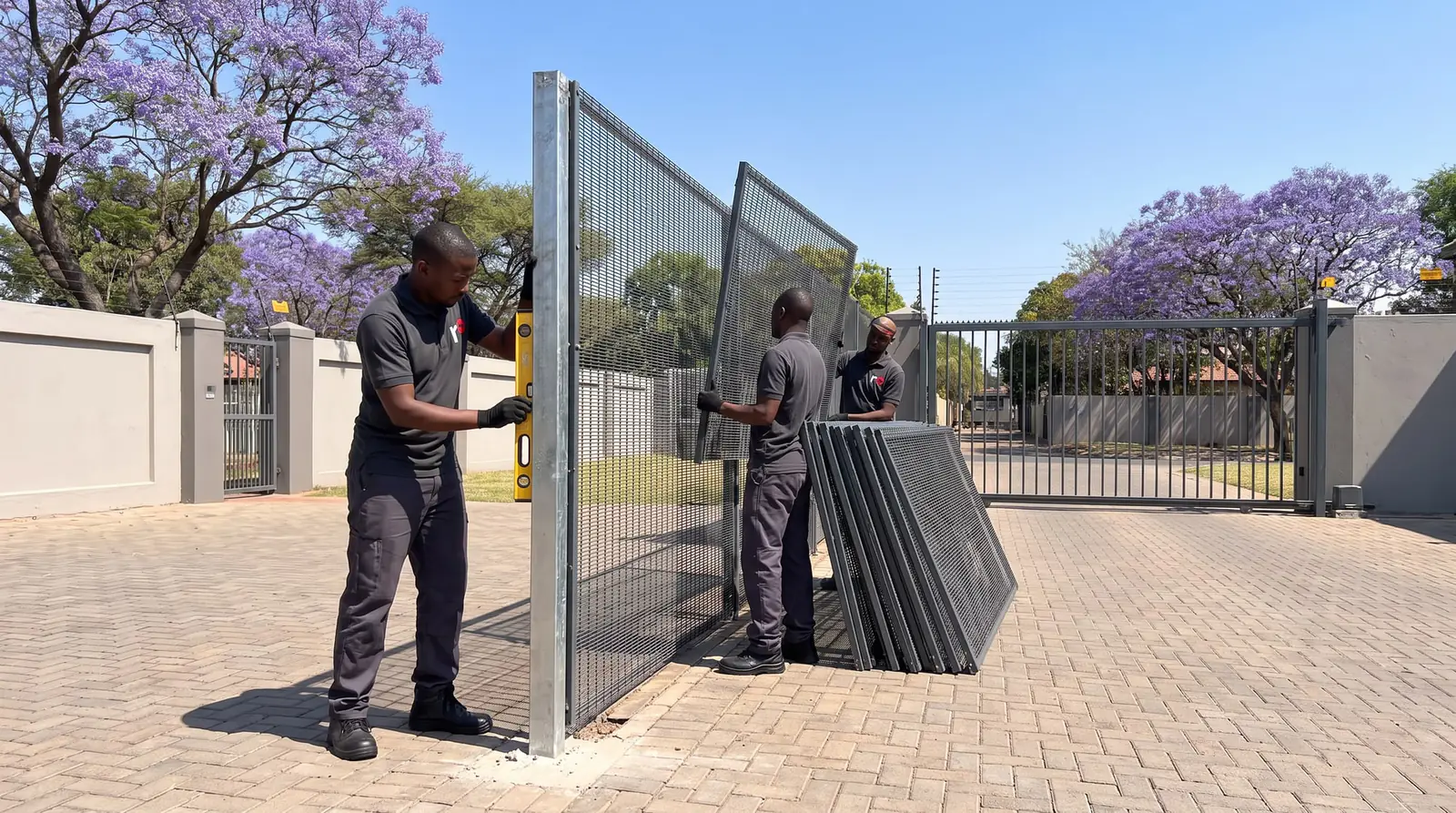
What weld mesh fencing is
Weld mesh is made by laying steel wires in a grid and welding them together at every crossing. Because each joint is welded rather than woven or twisted, the openings stay square, and cutting one wire doesn't let the rest unravel, which is how a woven diamond-mesh fence comes apart. The mesh is fixed to steel posts set in concrete, and it comes in two forms:
- Rolls, flexible enough to follow uneven ground, pulled tight between posts and tied to straining wires. The galvanised roll in the price table below is 1.8 m high and 30 m long.
- Panels, rigid sections clamped or bolted to the posts. Many are pressed with folds running along their length, which stiffen them and make them harder to push in.
The steel is galvanised against rust, and is often given a PVC or powder coat as well. Green weld mesh fencing blends into grass and trees, which is why it's seen around sports fields, parks and gardens; black and charcoal suit a house or a complex.
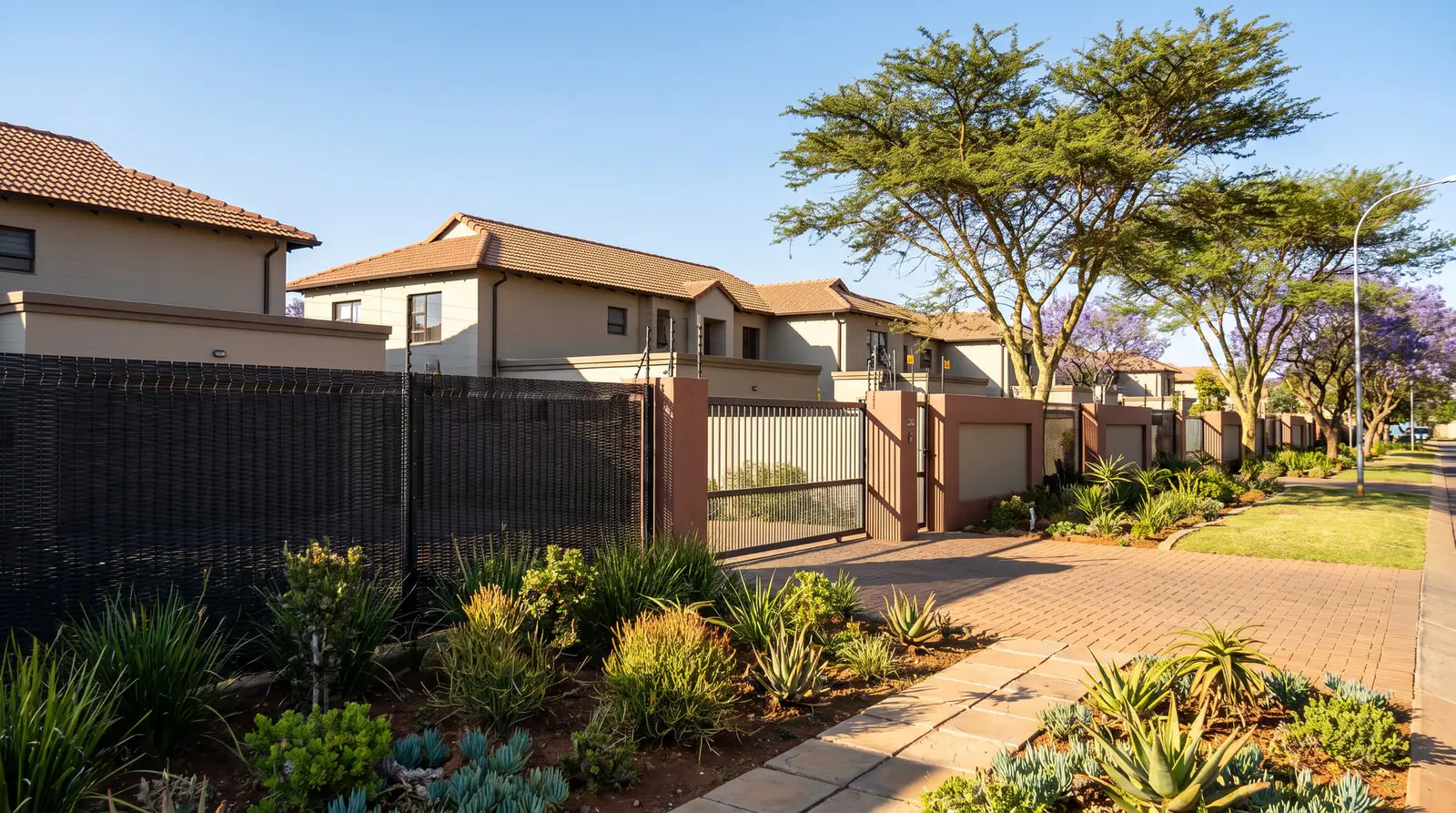
Openings, wire and height
Three measurements describe a mesh, and the shop label of a typical roll shows them together: 50 × 50 × 2 mm means openings 50 mm square, made of wire 2 mm thick.
- The opening. The smaller it is, the harder the fence is to climb. A 50 mm square still takes fingers and the toe of a shoe; the anti-climb mesh further down is made with openings too narrow for either. Rectangular openings are common too.
- The wire. Thicker wire is stiffer and slower to cut. Light garden mesh cuts easily; security mesh takes heavy cutters and time.
- The height. A waist-high mesh marks a boundary and keeps a dog in. A fence above head height is meant to keep people out, and a high weld mesh fence needs heavier posts, set deeper, to stay straight along its length.
What the fence has to keep in or out decides all three. Tell us when you book, and we'll recommend a combination on the site visit.
Weld mesh or palisade?
They do different jobs, and plenty of properties have both.
| Weld mesh | Palisade | |
|---|---|---|
| Look | Light and open; it can almost disappear, especially in green | Solid steel pales; a visible deterrent |
| Strength | Hard to climb with the right opening; lighter against impact | Pressed pales that resist bending and a vehicle |
| Typical cost, supplied and installed | R600–R800 a metre (ProCompare) | R1 100–R2 400 a metre (ProCompare); R1 200–R2 500 a metre (Completo) |
| Suits | Gardens, side and back boundaries, sports fields, complexes | Street fronts, entrances, business boundaries |
| Electric strands on top | On brackets above the mesh | On brackets above the pales |
Where a boundary is long, putting palisade only where it faces the road and mesh along the rest spends the money where the risk is. Palisade itself, its heights and its gates, is covered on steel palisade fencing.
Anti-climb and high-security mesh
Anti-climb fencing is mesh made so there's nothing to hold on to: openings too narrow for fingers or the toe of a shoe, and wire too thick for ordinary cutters. From a few metres away it looks almost transparent, so it's chosen where a fence must be both secure and see-through, such as complex perimeters, schools and business premises. ClearVu is one maker's name for it, so you'll often see it called ClearVu-type mesh.
It's sold as rigid panels clamped to their posts, and it's the most expensive of the mesh fences: R1 300–R1 600 a metre (ProCompare); R1 200–R1 700 a metre (Completo) supplied and installed, against R600–R800 a metre (ProCompare) for ordinary weld mesh. On a long perimeter it can be kept for the most exposed stretches, with ordinary mesh on the rest.
Electric strands on top of mesh
A mesh fence can carry live strands on brackets fixed to the tops of its posts, so anyone climbing the mesh meets the electric fence at the top. The electric part is a fence in its own right, built to the same rules as any other:
- The mesh is earthed, and the live strands sit on insulators, clear of it, so the steel never becomes part of the circuit.
- No razor or barbed wire goes close to the live lines, where it could trap someone.
- Warning signs go up at every gate and access point, and at least every 10 m.
- It gets its certificate when it's finished, as every new electric fence must.
Planning the strands with the mesh means the posts are long and strong enough to carry the brackets from the start. 2-year warranty and a compliance certificate on every new electric fence we install. How an electric fence is planned and built is on electric fence installation, and what the inspection checks on electric fence certificates.
How weld mesh is installed
The steps depend on whether it's rolls or panels:
- Mark the line and confirm the boundary, noting slopes, corners, gates and anything buried along it.
- Set the posts in concrete. For rolls, the strongest posts go at the ends, the corners and beside the gates, braced with stays, because they hold the pull of the whole run; lighter posts go in between. For panels, the posts are set one panel-width apart.
- Rolls: run straining wires along the posts at the top, middle and bottom, unroll the mesh against them, pull it tight and tie it to the wires and the posts.
- Panels: clamp or bolt each panel to its posts, keeping the tops level, or stepping them down a slope in even steps.
- Close the bottom. A gap under the mesh lets dogs out and people under, so the bottom edge stays close to the ground, or sits on a low concrete strip where the ground falls away.
- Hang the gates and check they close and latch.
- Touch up the cuts. Cut ends are painted with zinc paint, so the bare steel doesn't rust.
Rolls go up faster and follow rough ground better; panels make a straighter, stiffer fence that's harder to push in.
Repairing a mesh fence
Mesh fences get damaged in a handful of ways, and most can be put right without replacing the fence:
- A bent or cut panel is unclamped and replaced with one of the same size and coating.
- Sagging roll mesh is tightened again on its straining wires, and broken ties or wires are replaced.
- A hole cut in a roll is closed by tying in a piece of matching mesh, or by replacing that length of roll between two posts.
- A leaning post is dug out and reset in concrete, after a vehicle has hit it or the ground under it has washed away.
- Rust at the base, where grass and sprinklers keep the steel wet, is treated and the coating made good before it eats through the wire.
- Missing clamps and bolts are replaced, with tamper-resistant ones where they keep disappearing.
When you book, tell us roughly how long the damaged stretch is and add a photo, so we can bring matching mesh.
What weld mesh fencing typically costs
Typical market prices in Gauteng, not ours:
| What | Typical price |
|---|---|
| Weld mesh, supplied and installed | R600–R800 a metre (ProCompare) |
| ClearVu-type high-security mesh, supplied and installed | R1 300–R1 600 a metre (ProCompare); R1 200–R1 700 a metre (Completo) |
| Galvanised welded mesh roll (1.8 × 30 m, 50 × 50 × 2 mm), in shops | about R4 880 (Takealot) |
| ClearVu-type panel kit (1.8 × 2.5 m), in shops | about R4 600 (Takealot) |
| Steel pedestrian gate | R2 500–R6 000 (Completo) |
The height, the opening and wire, the coating, the number of gates and corners, the lie of the ground and any electric strands on top all move the total. Prices checked October 2026. Your exact price is set in a free quote before any work starts. No call-out fee when we do the work. If no work is done, a R650 call-out fee applies.
Areas
Weld mesh fencing near you
- Palisade and weld mesh · Alberton
- Palisade and weld mesh · Bedfordview
- Palisade and weld mesh · Benoni
- Palisade and weld mesh · Bryanston
- Palisade and weld mesh · Centurion
- Palisade and weld mesh · Douglasdale
- Palisade and weld mesh · East Rand
- Palisade and weld mesh · Edenvale
- Palisade and weld mesh · Fourways
- Palisade and weld mesh · Hyde Park
- Palisade and weld mesh · Inanda
- Palisade and weld mesh · Johannesburg
- Palisade and weld mesh · Kyalami
- Palisade and weld mesh · Melrose Arch
- Palisade and weld mesh · Midrand
- Palisade and weld mesh · Morningside
- Palisade and weld mesh · Randburg
- Palisade and weld mesh · Roodepoort
- Palisade and weld mesh · Rosebank
- Palisade and weld mesh · Sandton
- Palisade and weld mesh · Saxonworld
Questions
Weld mesh fencing questions
What is weld mesh fencing?
It's a fence of steel wires laid in a grid and welded at every crossing, fixed to steel posts as rolls or rigid panels. The welds keep the openings square and stop it unravelling when a wire is cut, and it's galvanised, often with a green or black coat on top. Read what weld mesh is.
How to install welded mesh fencing?
Set steel posts in concrete along the marked line, with braced posts at the ends, corners and gates if you're using rolls. Rolls are pulled tight along straining wires and tied off; panels are clamped or bolted post to post. Keep the bottom edge close to the ground and paint the cut ends. See every step.
Is welded mesh strong?
For its weight, yes: the welded joints hold the grid square, and cutting one wire doesn't open up the fence. How strong it is depends on the wire and the opening, from light garden mesh that cuts easily to anti-climb mesh that's slow to climb or cut. Against a vehicle, palisade is stronger. Compare openings and wire.
What is the price of welded mesh?
Supplied and installed, weld mesh typically costs R600–R800 a metre in Gauteng (prices checked October 2026). Bought on its own, a 30 m galvanised roll is about R4 880 in shops, before posts and labour. See typical prices.
What is the price of 50x50 weld mesh?
A galvanised roll with 50 mm square openings in 2 mm wire, 1.8 m high and 30 m long, is about R4 880 in shops (prices checked October 2026). That's the mesh only: the posts, straining wire, concrete and fitting are extra. See the price table.
What is anti-climb fencing?
It's steel mesh with openings too narrow for fingers or toes and wire too thick for ordinary cutters, so there's nothing to grip and it's slow to cut. It stays almost see-through from a distance, which suits complexes, schools and business premises. Read about anti-climb mesh.
How much does an anti-climb fence cost?
High-security anti-climb mesh typically costs R1 300–R1 600 a metre; R1 200–R1 700 a metre supplied and installed in Gauteng, against R600–R800 a metre for ordinary weld mesh. A 1.8 × 2.5 m panel kit is about R4 600 in shops (prices checked October 2026). See typical prices.
Book a technician
Get a palisade fencing quote
Job card
We WhatsApp or call you back. Fields marked (required) are needed.