Electric fences · Saxonworld
Electric fence repairs in Saxonworld, starting with a proper test
A fence that came with the house and nobody can explain, an extension that never seemed as strong as the rest, an energiser that beeps at odd hours: we repair, test and install electric fences across Saxonwold. 2-year warranty and a compliance certificate on every new electric fence we install.
2-year warranty and a compliance certificate on every new electric fence we install
Six-month guarantee on our repairs
Saxonworld and the areas around it. Every area we cover
A fence with a history
Saxonwold was laid out in 1925, and many of its electric fences are far younger than the walls they stand on, but old enough to have a history. A fence put up years ago may since have been extended when a wall was raised, patched after a storm, moved onto a new energiser when the old one failed, and worked on by two or three installers along the way, none of whom left a drawing.
So when you buy a house with a fence on it, or a fence you've lived with starts false-alarming, our first job isn't to replace anything. It's to find out what you've actually got, and whether it works as a fence should. JVA's installation manual for its Z28 energiser sets out the tests that do exactly that, and they apply to any well-built fence.
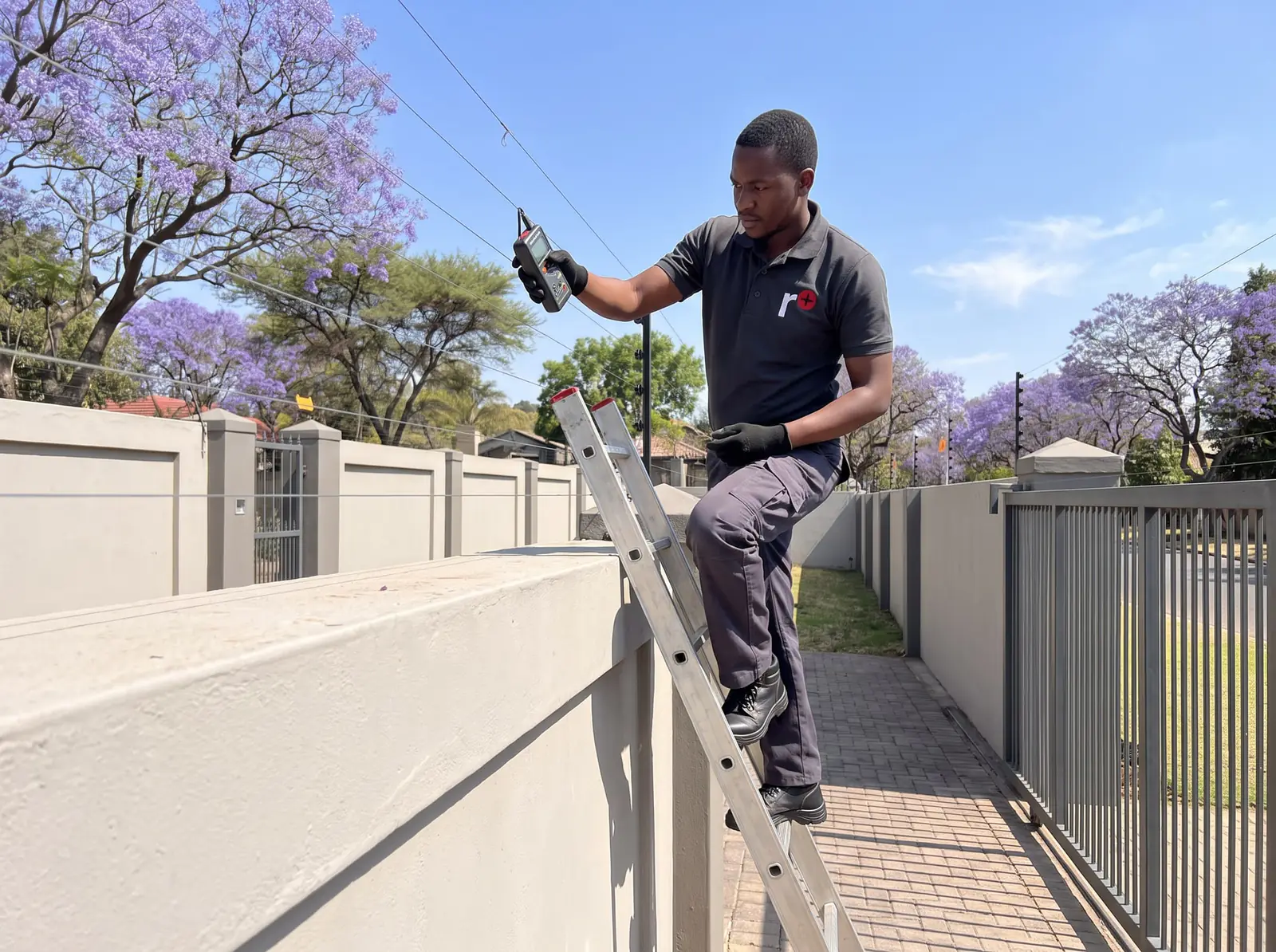
What we look at first
Before any meter comes out, a walk round the fence tells us a lot:
- The energiser: its make, model and age, whether parts are still available for it, and whether it was sized for the fence as it is now, or as it was before the extensions.
- The cable from the energiser to the fence. JVA's standards are blunt: the fence's high-voltage leads must never share a conduit with any other wiring.
- The joins, where every extension and repair meets the old fence. A loose or corroded join is one of the commonest causes of a weak or erratic fence.
- The earth: the earth spikes, their connections, and where they are. JVA's standards keep a fence's earth electrode at least 10 m from other earth systems.
- The brackets and insulators, especially on the oldest runs, where cracked insulators and rusted brackets leak current into the wall.
- What has grown into it since it was built.
The basic fence tests
JVA describes the basic tests for a fence in this order, and it's how we check one:
- Energise the fence.
- Walk it with a power probe, the fence tester that reads voltage along the wires, looking for faults in how it was built.
- Check every live wire has voltage on it all the way along, and that no live wire is shorted to earth.
- Check the earth. With a deliberate short from a live wire to earthed metal, the voltage at the earthed point should be no more than a few hundred volts, and so should the voltage between the earth stake and any earthed metal nearby. Much higher, and the earth isn't doing its job.
- Record the voltages at the start and the end of the live wires.
- Record the current going out from the energiser to the fence.
The figure that matters most: to be an effective barrier, the reading between a live wire and earth must be more than 5.0 kV everywhere on the fence, by JVA's figure. A fence that can't reach it may need a larger energiser, usually because it has grown longer than the one it started with.
Does it actually raise the alarm?
A fence that shocks but doesn't alarm only does half its job. JVA's fault condition tests check the other half:
- Simulate a break by opening a join in the live wires, taking care that nothing shorts to earth or between wires. The fence alarm must go off.
- Close the join again.
- Short the live wires at a point on the fence. The alarm must go off again.
- Remove the short, and repeat both tests on every zone.
If the alarm doesn't trip on a break, JVA's advice is to measure the voltage the monitor still sees and set the alarm level above it. A surprisingly high reading on a broken fence can mean voltage induced in the return wires, and JVA's remedy for that is a 3,000 ohm, 10 W resistor between the live return and earth return terminals at the monitor, a job for the technician on site.
All of this is done with care. JVA's own rule is common sense: turn the energiser off while changing anything on the fence, then switch it on again to check the effect.
Keep the readings
The start and end voltages and the current out, written down on the day of a test, are worth keeping with the house papers. The next time the fence is serviced, or starts acting up, the same readings taken again show at once what has changed: a voltage that has dropped at the far end, or a current that has crept up as plants or a cracked insulator start to load the fence. Without a first set, every fault is found from scratch.
An energiser that behaves strangely
Energisers like JVA's Z28 run on a microprocessor, and JVA points out that extreme electrical noise can upset one. The most likely source of that noise is the energiser's own high-voltage output: a lead that isn't firmly held in its terminal, or a join somewhere that's sparking. So when an energiser beeps at odd hours, resets itself or shows readings that make no sense, the first thing we check is that the high-voltage wiring is tight and that nothing is sparking.
JVA also notes that its Z28 is designed to recover from interference by itself, so there's no need to switch off both the mains and the battery to reset it. If you find yourself doing that to stop it misbehaving, something on the fence is causing it, and a reset only hides the cause.
A quiet night is a good time to listen: a fence that ticks or snaps at one spot is usually telling you where the problem is. Note where, and tell us, but don't touch the wires.
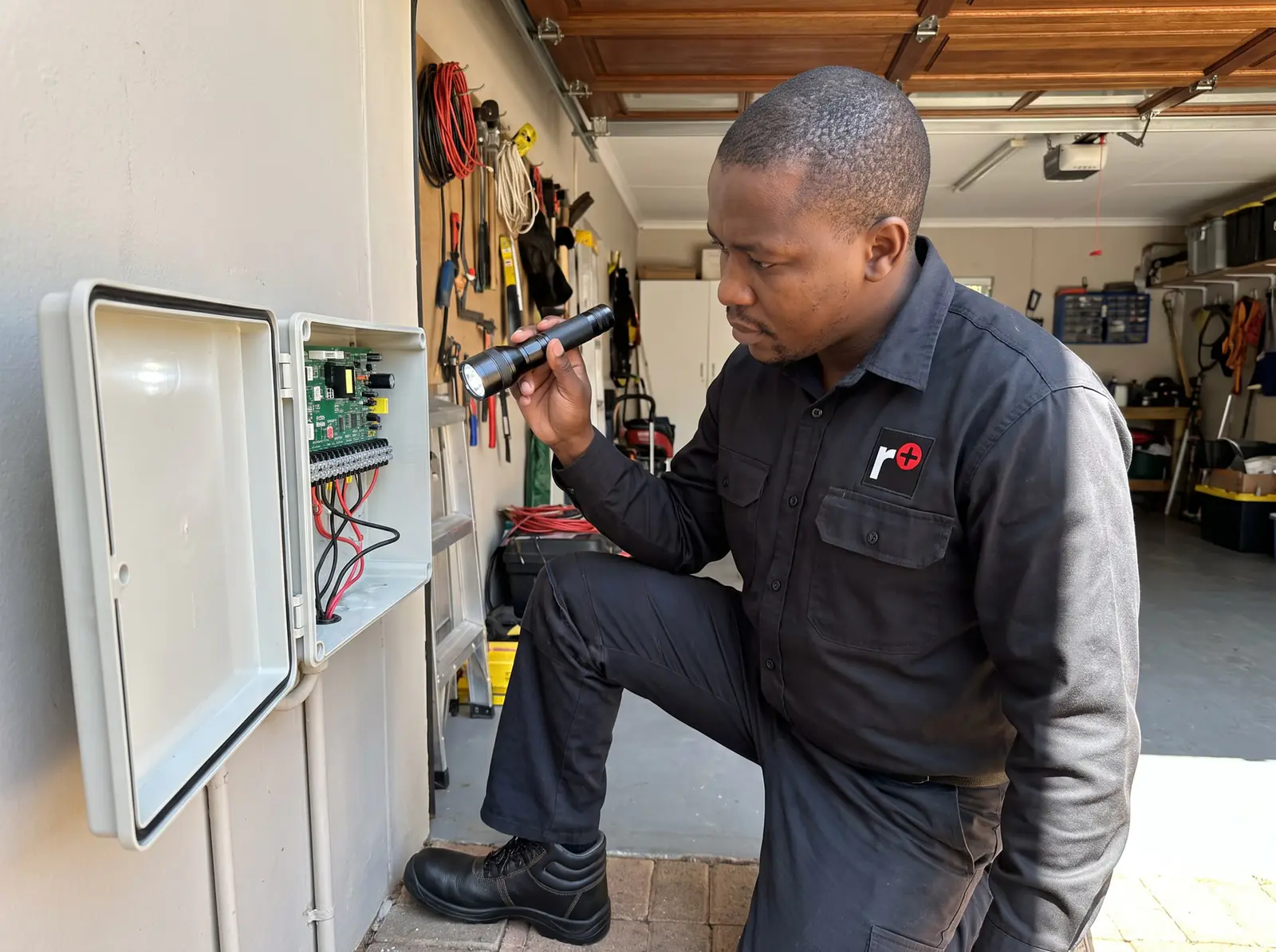
On an old wall
An electric fence on an old boundary wall sits on brick and mortar that may be a century old. Brackets fixed into soft or crumbling mortar work loose, and a bracket that moves can let a live wire touch metal. Where the top of a wall needs repair, it's done before the brackets go back. If you're thinking of raising an old wall to carry a taller fence, read the heritage note on our palisade page first.
Electric fence repairs in Saxonwold
We repair JVA and Nemtek energisers, keypads, sirens and strobes, and the fences themselves: broken and slack wires, loose joins, cracked insulators, rusted brackets, earth spikes and gate contacts. All our spare parts are genuine, and every repair comes with our six-month guarantee on our repairs. The fault finder below has the safe checks you can do first, none of which involve touching the fence.
New fences and certificates
Sometimes the tests show that an old fence isn't worth rescuing: an energiser too small for the length it now covers, wiring that can't be traced, brackets past repair. Then a new fence, planned on site, built to the standards JVA and Nemtek print, and tested along every zone, is the better buy. Certified electric fence installer. Selling or buying a house? See electric fence certificates.
What fence testing and repairs cost
Market prices in Gauteng from published cost guides, not ours:
- Fault-finding call-out: R500–R900 (Kandua)
- Simple repairs (insulators, a broken wire) including call-out: R700–R1 400 (Kandua)
- Complex faults or a new energiser: R1 500–R5 000+ (Kandua)
- Inspection and certificate for a fence that already complies: R850–R1 500 (Kandua, Completo)
Prices checked October 2026. Your exact price is set in a free quote before any work starts. No call-out fee when we do the work. If no work is done, a R650 call-out fee applies.
Booking a fence technician in Saxonwold
On the job card, give the energiser's make and model if you can see it, what the fence is doing, and whether you've just moved in. We work across Saxonwold, home to 2,557 people on 2.58 square kilometres at the 2011 census, and in nearby Parkview, Forest Town and Parktown North. Same-day repairs are offered when the day allows, and a fence that's down at night is treated as urgent.
Fault finder
What is your fence doing?
Pick what you're seeing for the likely causes, the safe checks you can do yourself, and when to stop and book. Taken from the manufacturers' own manuals.
What's it doing?
Likely causes
Electric fence · the alarm keeps going off
Most likely first
The fence voltage has dropped below the alarm level: something is touching the wires, or plants have grown into the fence.
The gate input is open: the gate isn't fully closed.
The fence condition is poor: dirty or failed insulators, or wet insulators after rain.
Safe checks you can do
When to stop and book
Never touch the fence wires or open the energiser. If the alarm won't clear, we'll find the fault on the fence.
From the official manuals: Nemtek Druid 25 and 28 user manual, Nemtek Druid LCD user manual.
Questions
Electric fence questions in Saxonwold
How do I know if an electric fence that came with my house works properly?
Have it tested: voltage on every live wire with no shorts to earth, the earth checked, readings recorded, and the alarm tested with a break and a short. Read about the tests.
What voltage should an electric security fence have?
More than 5.0 kV between a live wire and earth everywhere on the fence, by JVA's figure. Below that, it may need a larger energiser. Read more.
How is an electric fence alarm tested?
By opening a join to simulate a break and then shorting the live wires; each must set off the alarm, on every zone. Read about alarm tests.
Why does my energiser beep and reset itself at odd times?
Often electrical noise from its own high-voltage output: a loose lead or a sparking join. Have the wiring checked rather than resetting it. Read more.
Book a technician
Get an electric fence quote in Saxonworld
Job card
We WhatsApp or call you back. Fields marked (required) are needed.