Electric fences · Melrose Arch
Electric fence repairs in Melrose Arch, beside walkways and on buildings
A fence on a building's boundary wall beside a busy lane, a high-voltage cable that has to run down through three parking levels, a home's street wall in Melrose with signs that have faded to nothing: we repair and install electric fences across Melrose Arch. 2-year warranty and a compliance certificate on every new electric fence we install.
2-year warranty and a compliance certificate on every new electric fence we install
Six-month guarantee on our repairs
Melrose Arch and the areas around it. Every area we cover
Fences where people walk
Melrose Arch was laid out for people on foot, and its buildings meet the public along lanes, walkways and parking entrances. Around it, the homes of Melrose, Melrose Estate, Melrose North and Birdhaven have street walls along pavements. An electric fence in either place sits close to people who have every right to be there, so how it's built matters as much as how well it works.
Nemtek prints the rules it expects installers to follow at the back of its Druid installation manual. Most of them come down to one idea: the fence should shock only someone trying to get through it.
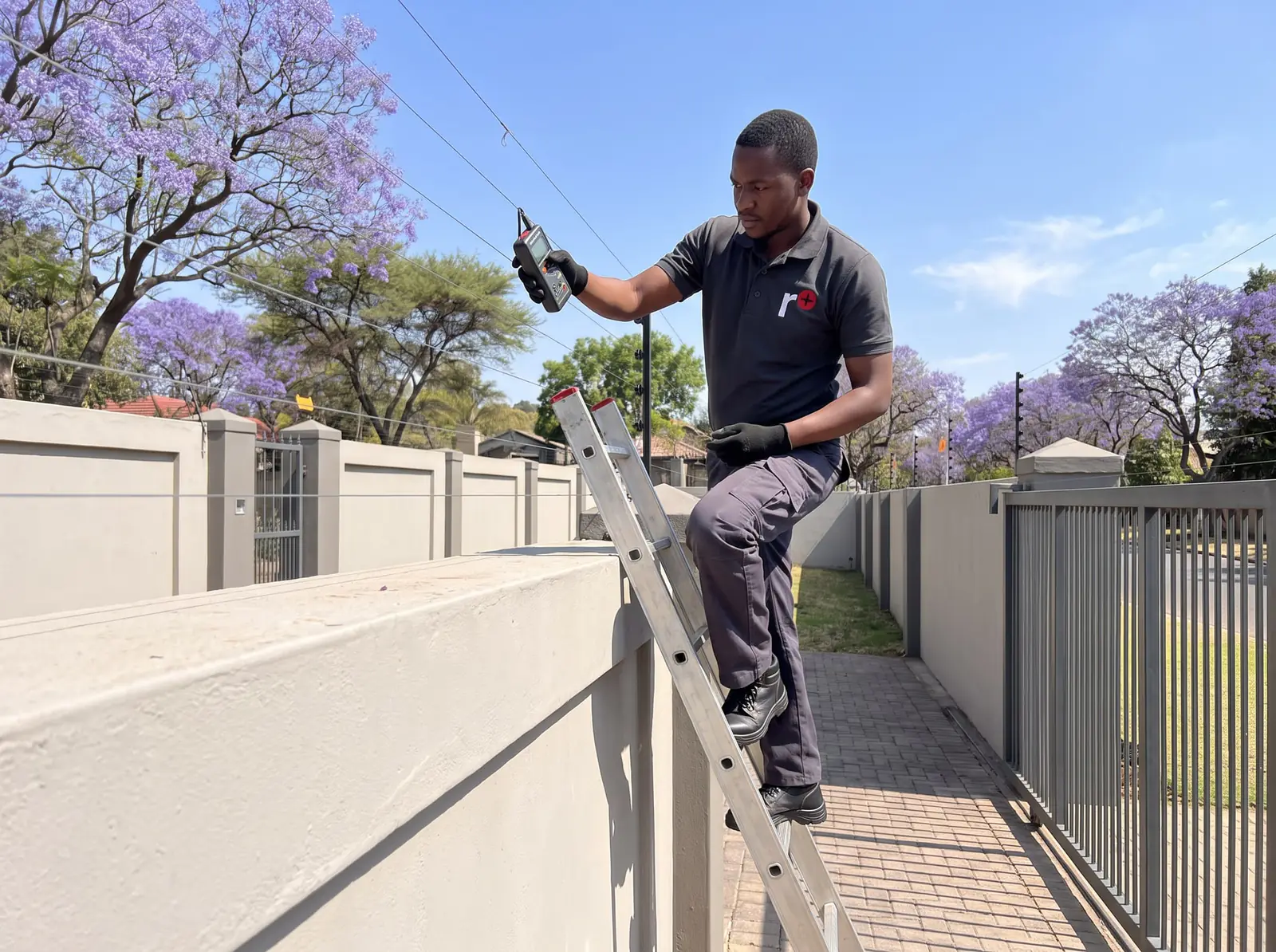
The public side and the secure side
Nemtek's manual draws a clear line between the two sides of a security fence:
- An electric security fence is an electric fence together with a physical barrier, such as a wall or steel fence, that's electrically separate from it.
- The public access area is the side where a physical barrier keeps people from touching the live wires by accident: the pavement or the lane.
- The secure area is the side where a person isn't kept from the live wires below 1.5 m by a barrier.
In practice, from the walkway, the wires should sit behind or above the wall or steel so nobody brushes them in passing. And any exposed metal of that barrier, such as a palisade or a steel railing, is earthed, so it can never become live itself.
Signs that read from both sides
Where a fence runs along a public road or path, Nemtek's rules call for warning signs, and they're specific about them:
- At least 100 by 200 mm, yellow on both sides, with black lettering at least 25 mm high, saying in substance "CAUTION: Electric fence".
- Readable from both sides, the secure side and the public side, with at least one on each side of the fence.
- Beside any chemical-hazard sign, so emergency services see both together.
Signs fade and fall off. On a building fence beside a walkway, they're the first thing we check, because missing signs are an easy thing to put right and a poor thing to be without.
High-voltage cable through a building
On a building, the energiser often sits in a plant room or a service area, a long way from the fence on the roofline or the boundary wall. The cable between them, which Nemtek calls the connecting lead, carries the fence's pulses, and its manual is strict about how it travels:
- Inside the building, it's insulated from the earthed structure, using insulated high-voltage cable.
- Underground, under a driveway or a parking level, it runs in an insulating conduit, or is itself insulated high-voltage cable, and is protected from damage.
- Never with other cables. It doesn't share a conduit with mains, communication or data cables, and the mains never shares a conduit with the fence's signalling wires.
- Never over power or phone lines. Neither the leads nor the fence wires may cross above overhead power or communication lines.
In a building with ducts already full of data and power cables, that often means a route of its own. It's worth planning before the ceiling boards go back.
When a building has more than one energiser
A large building often has several fences, on the street wall, the back boundary and a roof or podium, sometimes fed by different energisers installed at different times. Nemtek's rules for that:
- One fence, one supply. A single fence must never be fed from two energisers, or from two independent circuits of the same energiser.
- Leads kept apart. Bare connecting leads from separate energisers stay at least 2.5 m apart; they may be closer only where they're insulated cable, or sleeved with sleeving made for 10 kV.
On older buildings, where fences have been added piece by piece, these are among the first things we check, because getting them wrong is unsafe, and the faults it causes are hard to trace.
Energisers and keypads in a building
- A well-ventilated place for the energiser. Its lead-acid battery can vent, Nemtek warns, so a sealed cupboard is the wrong home for it.
- Weather protection for anything connected to the fence that sits outdoors, unless its maker says it's fit for outdoor use and it's at least IPX4.
- The same isolation from the mains, for every piece of equipment wired to the fence circuit, as the energiser itself gives.
- The keypad where the right people can reach it: at a security desk or a manager's office, not at a public entrance.
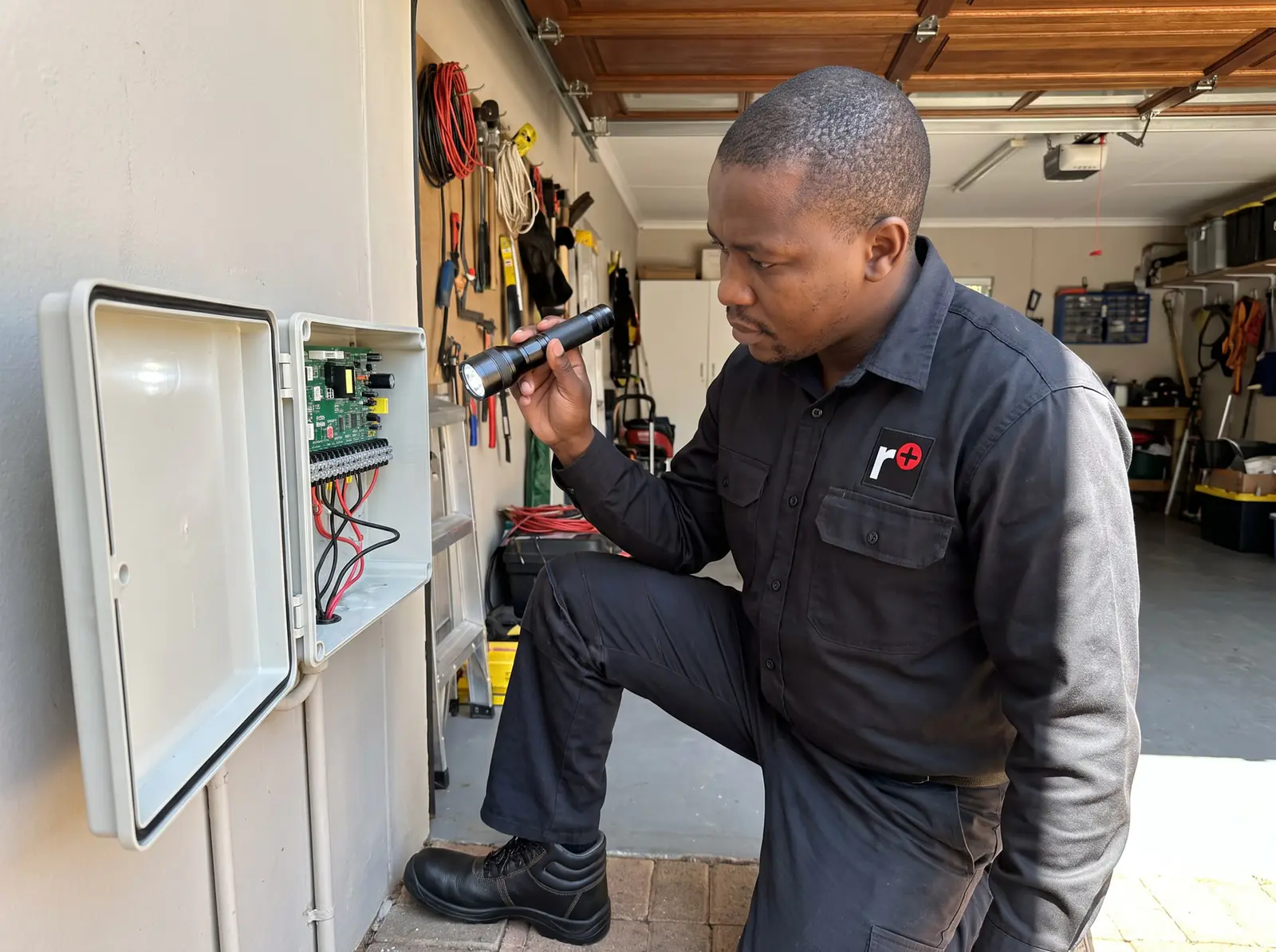
Looking after a building's fence
A building's fence belongs to its body corporate or owner, and is usually looked after through a managing agent. What keeps it working:
- One person responsible for the keypad codes and for who holds them, with codes changed when staff move on.
- A test along the fence, not just at the energiser: Nemtek's installation notes call for checking that a short and a break in the wires raise the alarm at points along the fence.
- The signs, the earth spikes and the insulators looked over at each visit.
- A record of each service, so the next technician knows what was done.
Electric fence repairs in Melrose Arch
We repair Nemtek and JVA energisers and keypads, high-voltage leads and their conduits, and the fences themselves: broken wires, cracked insulators, bent brackets, earth spikes, gate contacts, sirens, strobes and signs. All our spare parts are genuine, and every repair comes with our six-month guarantee on our repairs. The safe checks to try first, none of which mean touching the wires, are in the fault finder below.
New fences and certificates
A new fence on a home or a building is planned with you or the managing agent on site, including the cable route, built to the rules Nemtek and JVA print, tested along every zone and handed over with its certificate. Certified electric fence installer. For a certificate alone, see electric fence certificates.
Typical electric fence prices
Gauteng market prices from installer price lists and cost guides, not ours:
- 6-line wall-top fence, installed: R95–R115 a metre (published price lists of Gauteng installers)
- Fault-finding call-out: R500–R900 (Kandua)
- Complex faults or a new energiser: R1 500–R5 000+ (Kandua)
- Inspection and certificate for a fence that already complies: R850–R1 500 (Kandua, Completo)
Prices checked October 2026. Your exact price is set in a free quote before any work starts. No call-out fee when we do the work. If no work is done, a R650 call-out fee applies.
Booking a fence technician in Melrose Arch
On the job card, give the energiser's make, what the keypad or display shows, and whether it's a home or a building; for a building, add who manages it and where the energiser is. The precinct had 1,103 residents on 0.74 square kilometres at the 2011 census, and we work there and in the streets around it, out to Melrose Estate, Melrose North and Birdhaven. Same-day repairs are offered when the day allows, and a fence down at night is treated as urgent.
Fault finder
What is your fence doing?
Pick what you're seeing for the likely causes, the safe checks you can do yourself, and when to stop and book. Taken from the manufacturers' own manuals.
What's it doing?
Likely causes
Electric fence · the alarm keeps going off
Most likely first
The fence voltage has dropped below the alarm level: something is touching the wires, or plants have grown into the fence.
The gate input is open: the gate isn't fully closed.
The fence condition is poor: dirty or failed insulators, or wet insulators after rain.
Safe checks you can do
When to stop and book
Never touch the fence wires or open the energiser. If the alarm won't clear, we'll find the fault on the fence.
From the official manuals: Nemtek Druid 25 and 28 user manual, Nemtek Druid LCD user manual.
Questions
Electric fence questions in Melrose Arch
What is the secure area of an electric fence?
In Nemtek's terms, the side where a person isn't kept from the live wires below 1.5 m by a physical barrier; the public side is protected by the barrier. Read about the two sides.
What must an electric fence warning sign look like?
At least 100 by 200 mm, yellow on both sides with black lettering at least 25 mm high, readable from both sides of the fence. Read about signs.
Can electric fence cable run in the same conduit as other cables?
No: Nemtek's rules keep the high-voltage lead out of any conduit carrying mains, communication or data cables, and insulated inside buildings and underground. Read about cables.
Where should an electric fence energiser go in a building?
Somewhere well ventilated, since its lead-acid battery can vent, and out of the weather; the keypad goes where the right people can reach it. Read more.
Book a technician
Get an electric fence quote in Melrose Arch
Job card
We WhatsApp or call you back. Fields marked (required) are needed.