Electric fencing · East Rand
Electric fencing on the East Rand: repairs and new fences
A wall-top fence in Sunward Park that alarms whenever it rains, a long perimeter around a yard in Spartan that needs to say where it was cut, a new fence for a house in Primrose: we install and repair electric fencing across the East Rand. 2-year warranty and a compliance certificate on every new electric fence we install.
2-year warranty and a compliance certificate on every new electric fence we install
Six-month guarantee on our repairs
East Rand and the areas around it. Every area we cover
Electric fencing at two scales
Electric fencing on the East Rand comes at two scales. On houses and in townhouse complexes it's a wall-top fence of six to twelve lines above a garden wall or palisade, run by one energiser with a keypad by the door. Around factories, warehouses and yards, by the airport and along the industrial belts, it's a freestanding perimeter that can run for hundreds of metres, divided into zones and wired to a siren, an alarm panel and sometimes a control room.
The faults differ with the scale. A home fence is usually let down by plants, a tired battery or a storm. A long perimeter has those problems too, and adds its length, its earth system and the vehicles working beside it.
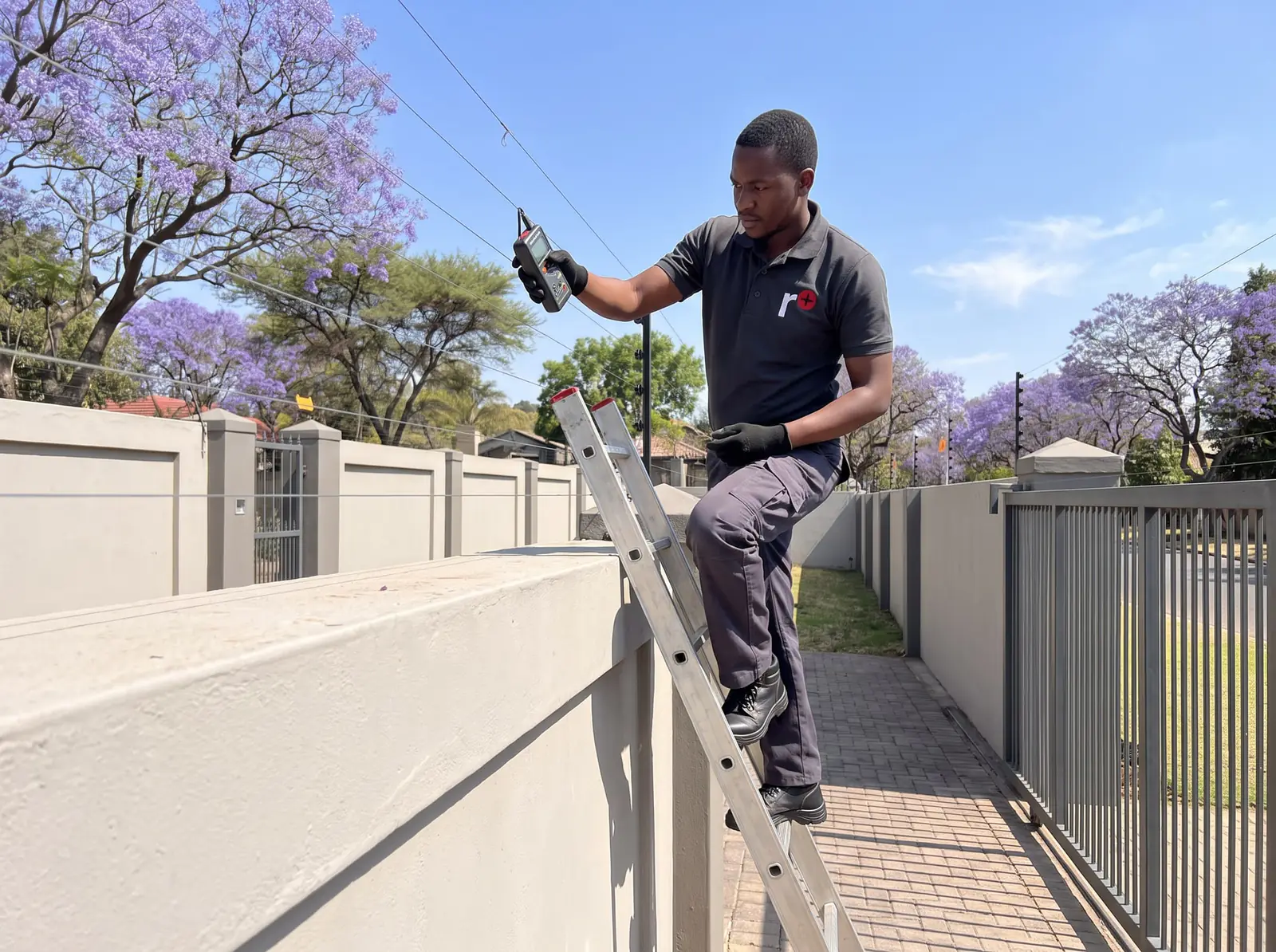
Watching a very long fence: JVA's ZM1
On a long perimeter, the hard part isn't keeping the fence live; it's knowing when and where it has failed. JVA's ZM1 is a monitor made for that job, paired with a separate energiser. From JVA's manual:
- No return wire needed. It measures the voltage and current going out on the fence's live feed, so it doesn't rely on a wire brought back from the far end. JVA points out that this can save a good deal on a new fence, and makes it possible to monitor an existing fence built without a return line. It can still watch a return line where there is one.
- Faults far down the line. Its Distant Fault Detection is designed to pick up a cut or a short on a very long fence, once the alarm levels have been set for that fence.
- Bridging. In its anti-bridging mode it alarms on a sudden change in the fence's load, as when wires are bridged.
- Big energisers and batteries. It works with an energiser of up to 36 J, and can run from a larger external battery and charger where the site needs longer back-up. It can also be set for a DC-only supply, as on a solar-powered fence.
JVA expects it on very large fences, such as game reserves and borders; on the East Rand, that means the longest industrial boundaries. On a smaller site, zones on one or two energisers usually do the job, and we'll tell you which suits yours.
The earth half of the circuit
An electric fence's shock is a circuit: the pulse leaves the energiser on the live wires, passes through whoever touches them, and returns through the fence's earth, made up of the earth spikes in the ground and, on many security fences, earth wires strung between the live ones. So the earth is half the fence, and a cut earth wire or a corroded connection at the spikes leaves it weaker than it should be.
JVA's energisers and monitors can watch the earth in three ways, as their manuals set out:
- Earth loop monitoring. The earth wiring runs out along the fence as a loop and back to a second earth terminal, so the energiser alarms if an earth wire is cut. On the Z28, JVA notes that only one earth spike location is then used.
- Earth spike monitoring, on the ZM1, which checks how well the energiser is earthed against a reference earth more than 10 m away.
- No earth monitoring, where only the live side is watched.
On industrial sites, the earth is easily damaged by work nearby: trenching, paving, or a forklift that catches a cable. After any digging along the boundary, have the earth checked.
Fences near overhead power lines
Some East Rand boundaries run beside or beneath overhead power lines, along servitudes and industrial roads. The standard requirements JVA prints in its Z28 manual set two rules for that:
| Power line voltage | Minimum clearance |
|---|---|
| Under 1,000 V | 3 m |
| 1,000 V to 33,000 V | 4 m |
| Over 33,000 V | 5 m |
- The clearance in the table is kept between the fence and the line.
- Where a fence passes under bare power line conductors, its highest metal part is earthed for at least 5 m on each side of the crossing.
We plan a new fence's route with both in mind. The lines themselves belong to the power utility, and we never work on them.
Who can switch the fence off
At a business, a fence is often armed and disarmed from more than one place: a key switch at the energiser, a keypad at reception, a remote, a GSM module on someone's phone, the alarm panel, or software in a control room. JVA's ZM1 manual makes a point worth knowing: with several controls, the most recent signal wins, and the higher-level ones, such as GSM and PC control, may override a key switch or keypad. Switching the fence off at the keypad doesn't promise that it stays off.
That matters whenever work has to happen near the wires. Before we work on a fence, we disarm it and, as JVA recommends, short the live wires to earth, so it can't be switched back on from somewhere else while we're on it. Anyone else should keep clear of the wires and call us.
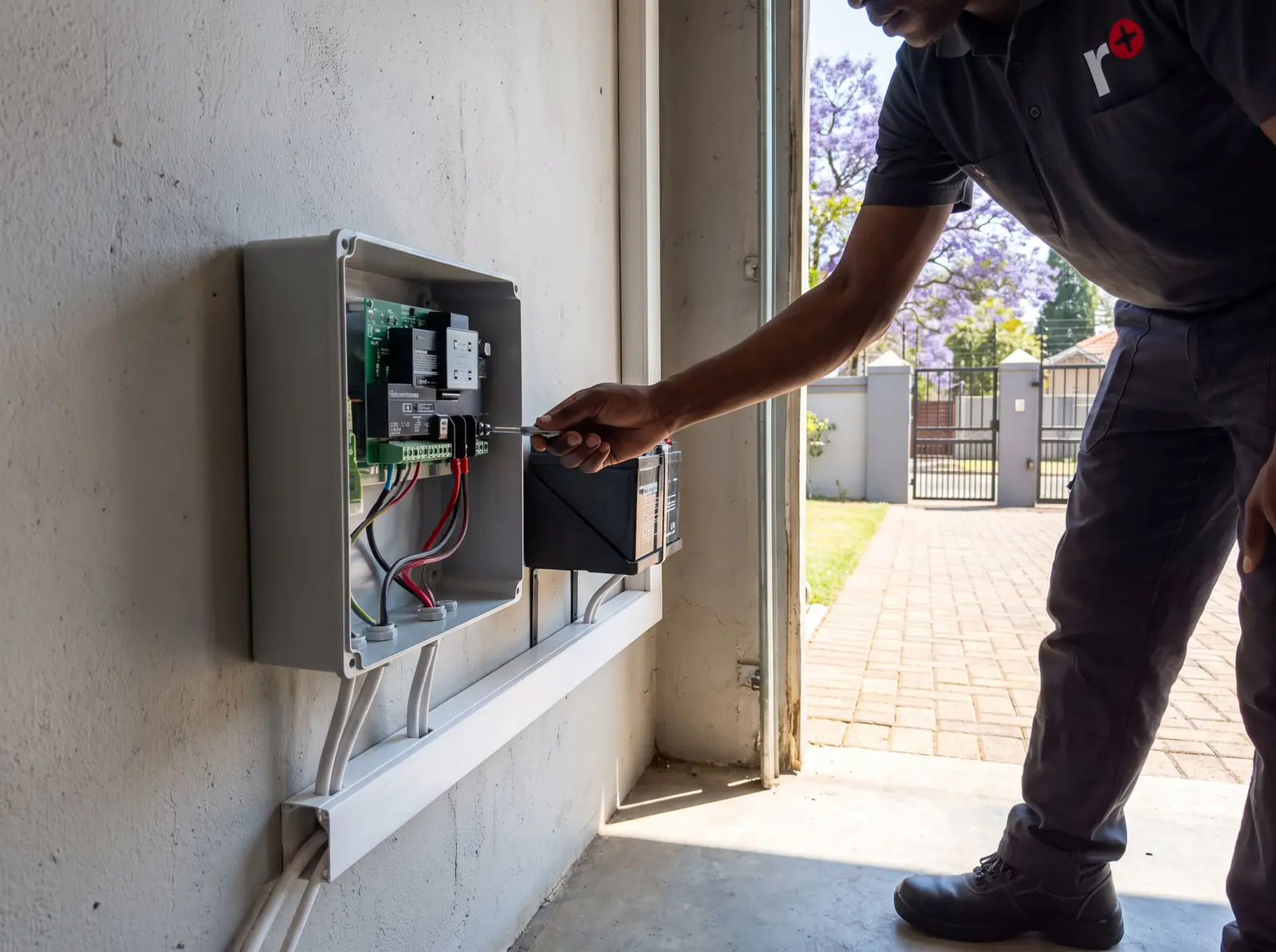
The fence, the cameras and the gate
On a site with a long perimeter, the fence works best as one part of a system. Its zones are wired to the alarm panel, so armed response or the control room knows which stretch alarmed. Cameras look along each zone, so whoever responds can see it before going out. And the gate's contact is wired in, so a gate left open shows as a gate alarm rather than a fence fault.
Gates in an electric fence must open without the person opening them getting a shock, and on a wide sliding gate for trucks that's planned when the fence goes up. We work on the fence, the gate motor and the cameras, so the pieces can be set up to work together.
Homes and complexes
On East Rand houses, the familiar faults come round with the seasons: grass and creepers reaching the lower wires in summer, false alarms after rain, an energiser's board lost to a storm, and a battery that no longer carries the fence through load-shedding. In townhouse complexes the perimeter fence is shared, so tell us whether the body corporate or an owner is booking, and who should get the report.
Electric fence repairs on the East Rand
- A fence that alarms constantly: plants, a broken insulator, a wire touching a bracket, or a fault in the earth.
- A dead fence: a failed energiser, a flat battery, or a board taken out by a surge.
- Low voltage on the display: something loading the fence, such as plants or a shorted insulator, or an earth problem.
- A fault somewhere on a long run: found zone by zone, then stretch by stretch.
- Keypads, sirens and gate contacts that have stopped reporting.
All our spare parts are genuine, and every repair comes with our six-month guarantee on our repairs. The checks that are safe to do yourself, without touching the wires, are in the fault finder below.
New electric fencing on the East Rand
A new fence starts with a walk of the boundary to settle the details: wall-top or freestanding, how many lines, where the zones divide, where the energiser, keypad and earth spikes go, and whether a power line, a neighbour's fence or a truck gate needs planning around. We build it to the rules Nemtek and JVA print in their manuals and hand it over with its certificate. Certified electric fence installer. If you're selling and only need the certificate, see electric fence certificates.
Typical electric fencing prices
Market prices in Gauteng, from installer price lists and cost guides, not ours:
- 10-line wall-top fence, installed: R130–R145 a metre (published price lists of Gauteng installers)
- 18-line freestanding fence, installed: R205–R225 a metre (published price lists of Gauteng installers)
- 30-line freestanding fence, installed: R350–R400 a metre (published price lists of Gauteng installers)
- Simple repairs (insulators, a broken wire) including call-out: R700–R1 400 (Kandua)
- Complex faults or a new energiser: R1 500–R5 000+ (Kandua)
Prices checked October 2026. Your exact price is set in a free quote before any work starts. No call-out fee when we do the work. If no work is done, a R650 call-out fee applies.
Booking a fence technician on the East Rand
On the job card, say whether it's a home or a business, roughly how long the fence is, the energiser's make if you know it, and what it's doing. We work across the East Rand: Germiston, Primrose and Elsburg; Boksburg, Reiger Park and Sunward Park; Kempton Park, Edleen, Esther Park and Rhodesfield; Brakpan and Springs; and the industrial areas around Isando and Spartan. Same-day repairs are offered when the day allows, and a business fence that's down after hours is treated as urgent.
Fault finder
What is your fence doing?
Pick what you're seeing for the likely causes, the safe checks you can do yourself, and when to stop and book. Taken from the manufacturers' own manuals.
What's it doing?
Likely causes
Electric fence · the alarm keeps going off
Most likely first
The fence voltage has dropped below the alarm level: something is touching the wires, or plants have grown into the fence.
The gate input is open: the gate isn't fully closed.
The fence condition is poor: dirty or failed insulators, or wet insulators after rain.
Safe checks you can do
When to stop and book
Never touch the fence wires or open the energiser. If the alarm won't clear, we'll find the fault on the fence.
From the official manuals: Nemtek Druid 25 and 28 user manual, Nemtek Druid LCD user manual.
Questions
Electric fence questions on the East Rand
Can an electric fence be monitored without a return wire?
Yes, with a monitor such as JVA's ZM1, which measures the voltage and current on the live feed instead. That can save cost on a new fence and lets an older fence without a return line be monitored. Read about long fences.
How far must an electric fence be from a power line?
The standard JVA prints sets at least 3 m for lines under 1,000 V, 4 m up to 33,000 V and 5 m above that, with the fence's top metal earthed where it passes under bare conductors. Read about power lines.
Why did our electric fence come back on after we switched it off?
Where a fence has several controls, the most recent signal wins, and GSM or PC control can override a keypad or key switch. Someone else may have armed it. Read who can switch it off.
What is earth loop monitoring on an electric fence?
The earth wiring runs along the fence as a loop back to a second terminal on the energiser, so it alarms if an earth wire is cut. Read about the earth.
Book a technician
Get an electric fence quote in East Rand
Job card
We WhatsApp or call you back. Fields marked (required) are needed.