Manual · Gemini garage
Gemini garage door motor manual: remotes, limits and faults
Gemini, made by DMI Engineering, builds a 24 V garage door operator for sectional and tip-up doors and two for roll-up doors, including a newer one that learns its own limits. They share a chain drive, a learn button for up to 30 remotes and a lock-out button on the wall console. Here is how each is set up from Gemini's manuals, how to add or clear remotes, what the flashes and faults mean, and what a Gemini garage motor costs.
Six-month guarantee on our repairs
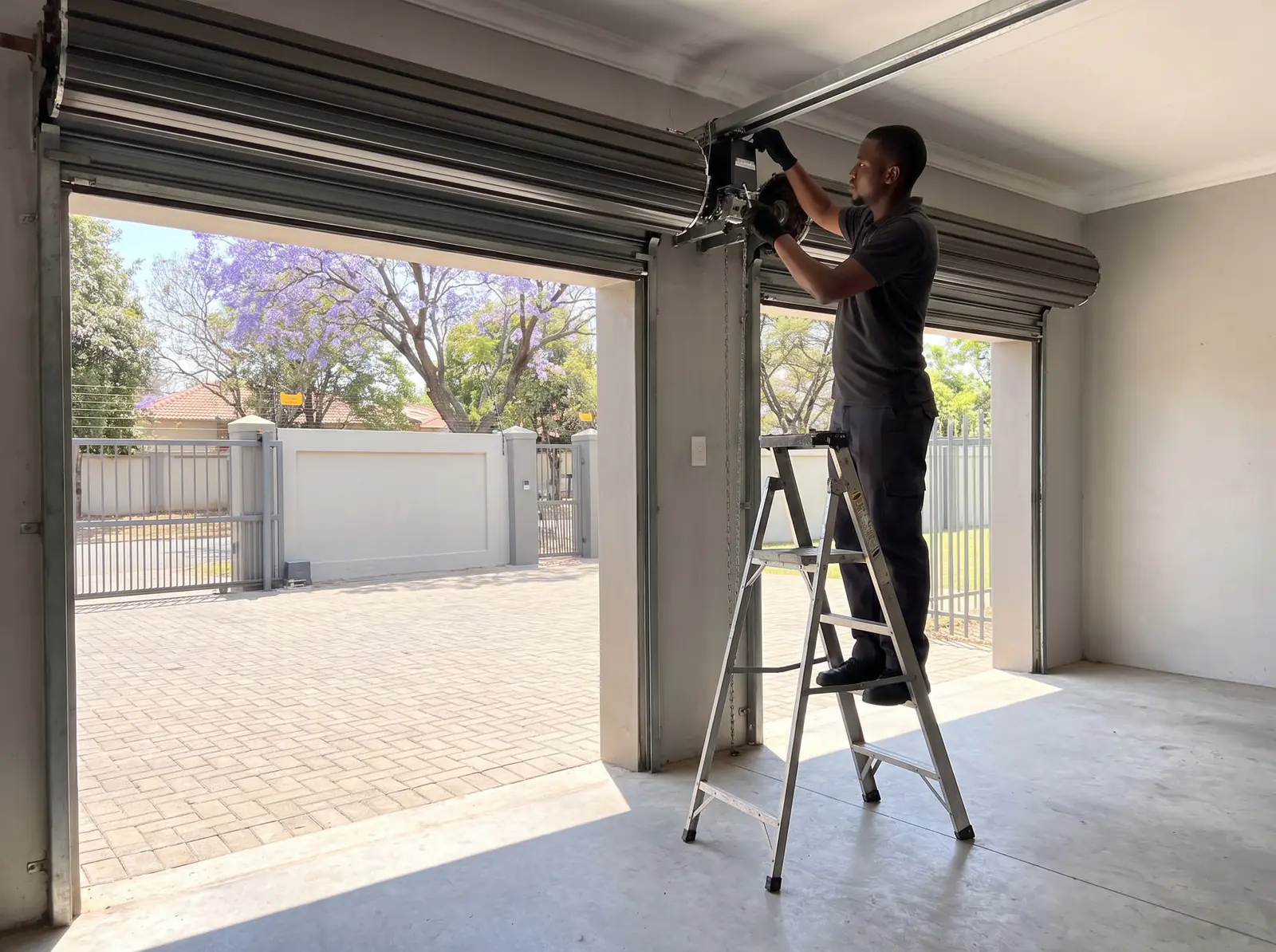
Gemini's garage door operators
| Operator | Doors | How it knows where to stop |
|---|---|---|
| 24 V garage door operator | Trackless tip-up and sectional | Two magnetic sensors on an aluminium rail, open and closed |
| Roll-up operator (older) | Roll-up | The same rail and magnetic sensors, standing beside the door |
| Limit-learning (LL) roll-up operator | One roll-up door up to 2,550 mm wide, or two side by side | It learns the limits itself on its first run |
All three drive the door through a 24 V motor, a worm gearbox and a chain that Gemini calls maintenance-free.
| 24 V garage door operator | |
|---|---|
| Motor | 24 V DC, 35 W, worm drive |
| Pull | 10 kgf |
| Speed | 11 m a minute |
| Use | About 20 openings a day (Gemini says it varies with the door and battery) |
| Battery | Two 12 V, 2.4 Ah |
| Remotes | Up to 30 on the onboard receiver |
| Duty cycle | 75% |
It's built for homes. A door used all day, such as a complex's shared garage, needs a heavier operator.
The door must be right first
Gemini is blunt: never try to fix an unstable or jamming door by fitting a motor, because it can cause serious injury or damage. The door must open easily by hand. Gemini also warns that a door can fall back fast when the traveller is released if its springs are weak or broken, or it's out of balance, so check the springs and mountings often and don't use the door if they need attention. See garage door springs.
On the LL roll-up operator, the motor stands between two doors, or between a door and the side wall, and needs at least 180 mm beside the door, 2,540 mm from floor to ceiling (2,800 mm for a caravan door), and the door's shaft exactly level.
Adding a remote to a Gemini garage motor
The remotes in the box come already learnt. To add another, or the wireless wall console:
- Open the motor's cover so you can reach the button on the control card (the learn button on the LL roll-up; the function button on the sectional operator).
- Press and hold the button on the new remote.
- While holding it, press and release the button on the card.
- The receiver light on the card flashes twice. Let go of the remote.
- Repeat for the next remote, up to 30.
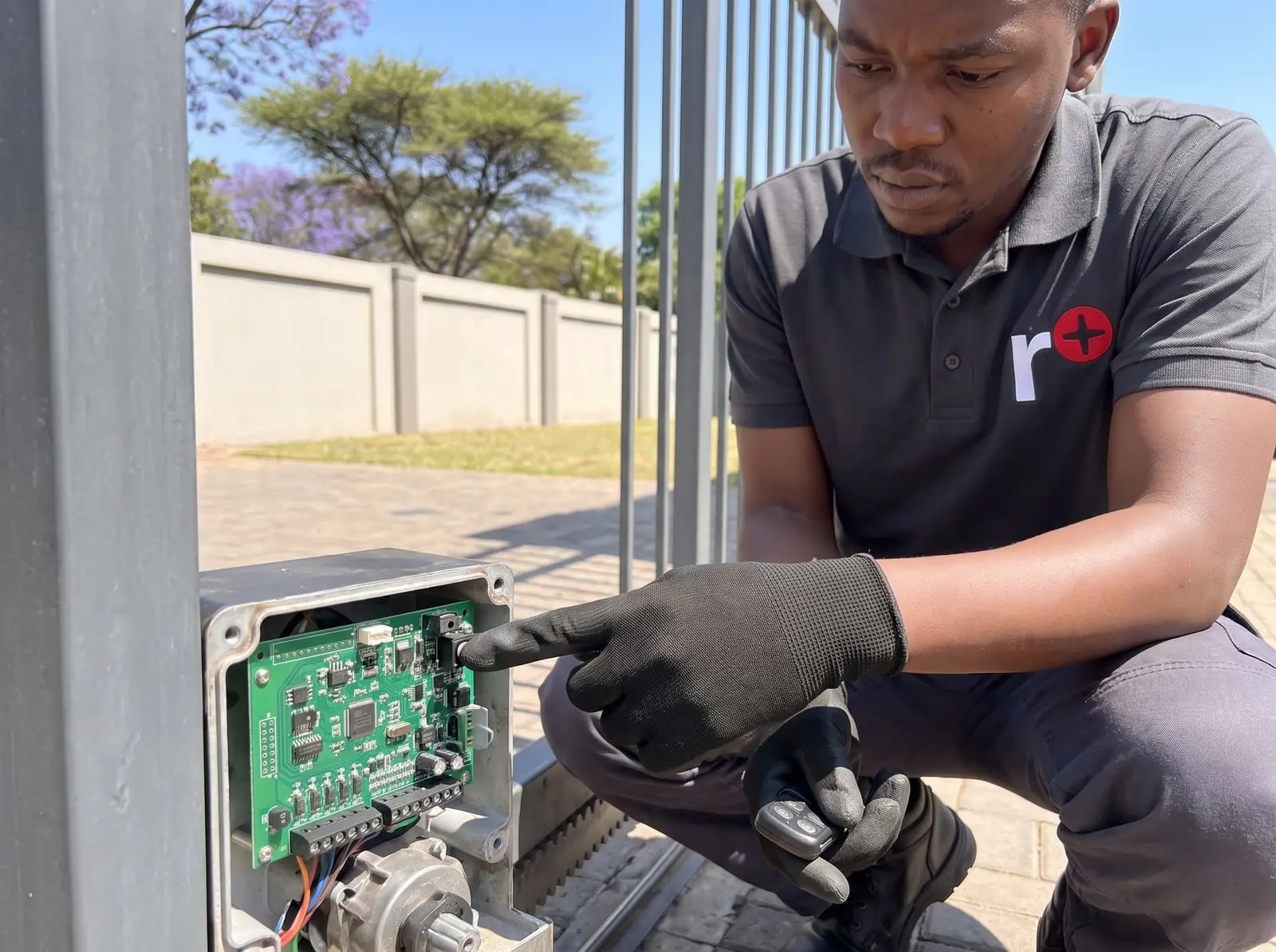
To clear every remote: press and hold the FUNCTION button for about 10 seconds, until the receiver light goes off. Then learn back the remotes you're keeping. It's the only way to remove a lost or stolen one, because Gemini's manuals give no way to delete a single remote.
The card is under the motor's cover, near its mains connections. If you'd rather not open it, we'll code remotes on site.
Lock-out, and the light flashing three times
The wireless wall console has a lock button. Pressed, the motor's light flashes once and the remotes stop working; pressed again, it flashes twice and they work again.
While it's locked, pressing a remote makes the light flash three times quickly and nothing moves. It's easy to mistake for a fault: Gemini's troubleshooting table lists it, and the fix is one press of the lock button on the wall console.
Setting where the door stops
Sectional, tip-up and older roll-up operators stop at two magnetic sensors on the aluminium rail. The open sensor is the one nearest the motor-head, the closed sensor the one furthest away. To set them, release the traveller, move the door fully open and slide the open sensor until it lines up with the traveller; then close the door fully and do the same with the closed sensor. Gemini's test runs the motor with the traveller released while you move the door by hand, to check each sensor switches the motor off at the right point.
The LL roll-up learns its limits:
- With the traveller engaged and the batteries connected, press the remote, the button on the card or the app.
- The door moves slowly to its first limit. It must close first; if it opens, the direction dipswitch (number 2) goes the other way.
- Press again: it runs slowly the other way to its second limit and stops. The limits are now learnt.
Once set, pressing the remote while the door is closing stops it and opens it; while opening, it stops and waits. If yours does the reverse, the direction is wrong.
Testing the obstruction sensing
Gemini's test, from the LL roll-up manual: with the door fully open, put a solid object about 400 mm high under it, where the door's edge will meet it squarely (Gemini suggests a bin, with a bathroom scale on top to read the force). Stand clear and close the door. It should stop and go back once it meets about 5 to 10 kg of resistance.
If it needs adjusting, the sensitivity is set on the control card: dipswitches on the LL roll-up, a small adjuster on the sectional operator (clockwise makes it less sensitive). Gemini sets it in the factory and expects it to be adjusted to the door's weight. A door that only reverses when pushed much harder needs a technician, not a higher setting.
Opening the door by hand
If the motor fails, open the door from inside the garage:
- Switch off the power to the motor.
- Pull the emergency release cord down. The traveller lever moves from flat (engaged) to upright (released).
- Open and close the door by hand.
To re-engage, move the door to about halfway and pull the cord again; the lever returns to flat. Gemini asks you to re-engage the traveller after closing the door, because the engaged traveller is what holds the door shut. Take care releasing a door with weak or broken springs: it can drop. More on other makes is in how to open a garage door manually.
Gemini's troubleshooting table
| Symptom | Likely cause | What to do |
|---|---|---|
| Nothing happens at all | Power off, battery pack flat or disconnected | Check the plug and switch; batteries are a technician's job |
| Motor runs but the door doesn't move | The traveller is released | Re-engage it |
| Light flashes three times, door doesn't open | Lock-out is on | Press the lock button on the wall console |
| Works from the wall button but not the remote | Remote not learnt, flat or faulty | New remote battery; learn it again |
| Opens only a short way | Door too heavy, something in the track, or sensitivity too high | Clear the track; then call us |
| Clicks but doesn't start | Sensors set wrongly, or the card needs a reset | A technician's job |
| Opens and closes by itself | Faulty button wiring or receiver, or someone nearby on the same frequency | Clear the receiver and learn the remotes again; otherwise call us |
| Poor range | Remote battery flat, receiver blocked or its aerial bent | New battery; straighten the aerial |
Gemini's own maintenance is light: keep the door's tracks clear of dirt and sand, never grease the channels (only dry graphite on the contact pads), and blow the dust out of the motor-head every six months. More in how to service a garage door motor.
What a Gemini garage motor costs
| Motor | Typical shop price |
|---|---|
| Gemini 24 V roll-up motor | about R3 970 (Takealot) |
That's the motor alone, without installation. The manufacturer's guarantee runs 24 months, but 12 on the electronics and none on batteries, and it excludes lightning and flood damage. Prices checked October 2026. Other garage motors and installed prices are compared on garage door motor prices. Your exact price is set in a free quote before any work starts. No call-out fee when we do the work. If no work is done, a R650 call-out fee applies.
When to call us
Call us for a Gemini garage motor that clicks but won't start, won't hold its limits, reverses for no reason, or no longer runs through a power cut. We repair and install Gemini garage operators, replace batteries and remotes, and service the doors they drive. All our spare parts are genuine, and every repair carries our six-month guarantee on our repairs.
Gemini's own documents:
- Gemini Garage door operator (spec sheet): the 24 V operator's specifications
- Gemini Sectional / tip-up garage door operator, installer manual: sectional and tip-up doors
- Gemini Roll-up garage door operator, installer manual: the older roll-up operator
- Gemini LL roll-up garage door motor (2025), installer manual: the limit-learning roll-up operator
Gemini's gate motors are on the Gemini gate motor manuals, and the brand on Gemini.
Questions
Gemini garage questions
How to program Gemini garage door remote?
Hold the new remote's button, press and release the learn or function button on the motor's control card, and wait for the receiver light to flash twice; then let go. It holds up to 30 remotes. See the steps.
How to set a Gemini garage door remote?
If the remote has stopped working rather than never worked, first check lock-out: three quick flashes of the motor's light when you press it means the wall console's lock button is on. Otherwise replace the remote's battery, then learn it again on the control card. See lock-out.
Book a technician
Get a garage door quote
Job card
We WhatsApp or call you back. Fields marked (required) are needed.