Guides · Gates
Sliding gate off track: what to do first, and why it happened
A sliding gate that has come off its track is one of the few gate faults that is dangerous as well as inconvenient: a gate off its rail can lean, jam or fall. Here's what to do in the first few minutes, why gates leave the track, how the wheels, rail, guide rollers and stoppers are meant to keep them on, and what a proper repair involves, so it doesn't happen again.
Six-month guarantee on our repairs
24/7 emergency repairs across Gauteng
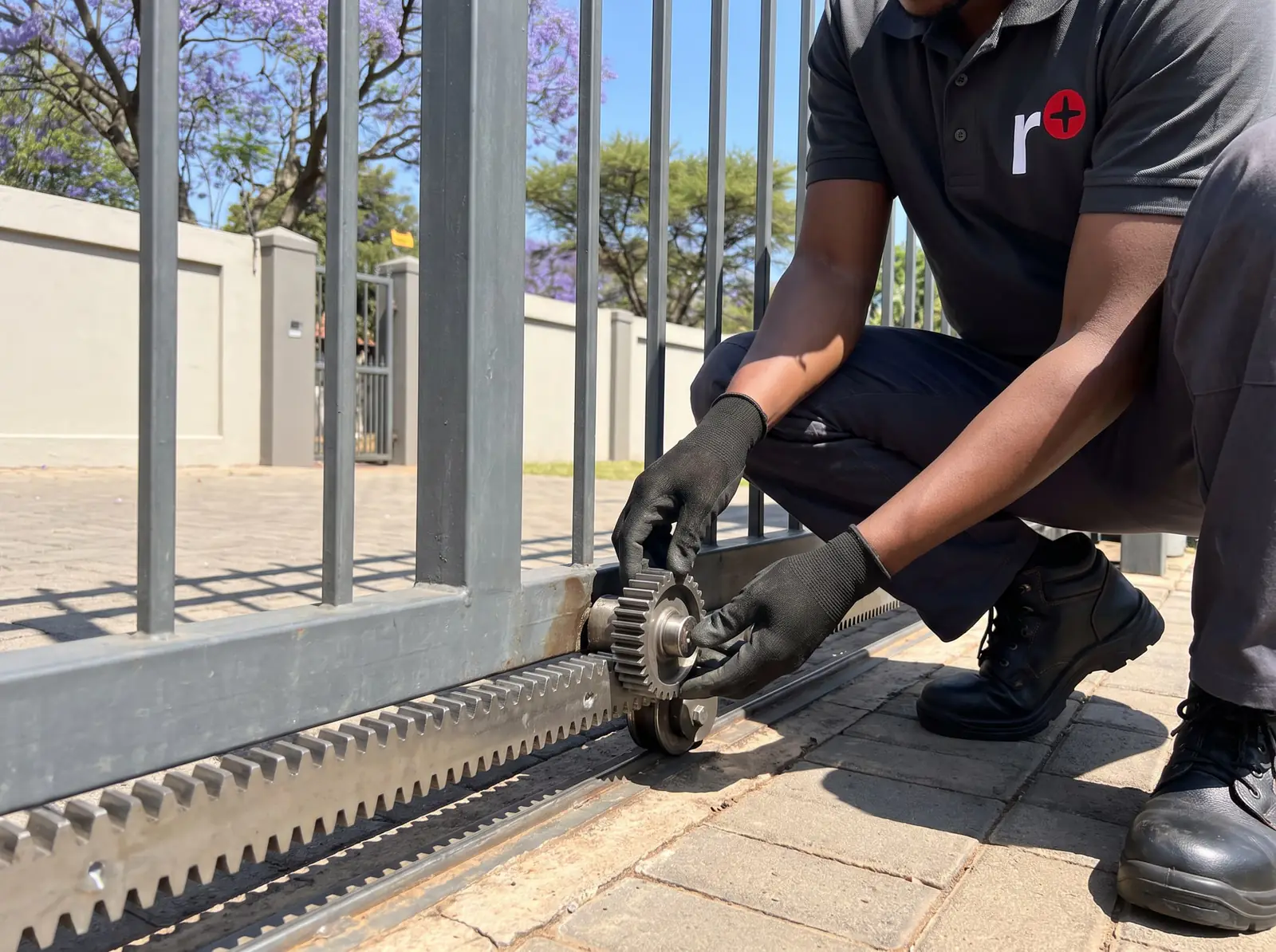
First: keep everyone clear
A sliding gate is held upright by its wheels on the rail and the guide rollers at the top. Once a wheel has left the rail, those rollers may be all that's holding the gate up, and a sliding gate is heavy: the motors that drive them are built for gates of several hundred kilograms.
- Keep people, children and pets away from the gate and both sides of it.
- Don't run the motor. Switch it off at its isolator or plug point if you can reach that without going near the gate. Driving a gate that's off its track can push it further over or damage the motor's gear.
- Don't try to lift it back. It's heavier than it looks, it can swing as it comes free, and a wheel dropping back onto the rail can trap fingers.
- Leave the motor engaged. Releasing it lets the gate move freely, which is the last thing a gate off its track should do.
If the gate is leaning or the property is open, call us straight away: the 24/7 emergency repairs across Gauteng are for exactly this. Until then, keep the car and valuables out of reach and keep watch on the gap.
Why sliding gates come off the track
Any of these can do it, and they tend to build on each other:
- Missing or low end stoppers. Centurion calls endstops mandatory, and they must stand taller than the wheel so the gate can't ride over them. ET's manual makes stoppers at both ends of the track a national safety standard requirement, and Gemini warns that a gate must never be able to overrun its track. A gate that overruns its limits with no stopper simply rolls off the end.
- Worn wheels and bearings. A wheel with a worn groove or a failing bearing wobbles and runs badly, and a wobbling wheel can climb out of the rail.
- Debris in the rail. Stones, sand and a lip of soil lift a wheel each time it rolls over them.
- A bent or uneven rail. Gemini's manual warns against bends where the wheels can jam and against any change in track height along its length. A rail knocked by a car, or one that has sunk where water pools, does both.
- Guide rollers that have failed or been set badly. The guides at the top keep the gate upright; if one breaks or binds, the gate leans and the wheels lift on one side.
- A gate that has been lifted. Someone trying to lift a gate off its motor can lift it off its rail too. That's what anti-lift brackets prevent.
A gate that has been dragging for a while will also have been making the motor work harder.
What keeps a sliding gate on its track
| Part | What the manuals ask for |
|---|---|
| Track (rail) | Secure, straight, level and clear of obstructions, with no bends or changes in height |
| Wheels | ET recommends steel or steel-alloy wheels of at least 100 mm on sealed roller bearings; Gemini's slider specifications assume wheels of at least 80 mm with roller bearings |
| Wheel profile | Matched to the rail: a wheel groove that doesn't fit the track runs badly and climbs |
| Guide rollers | Nylon-clad sealed bearings at the top edge, never below halfway, never touching both sides of the gate at once |
| End stoppers | At both ends, taller than the wheel, strong enough to stop the gate at full speed |
| Anti-lift brackets | Within 5 mm of the gate, so it can't be lifted off the motor's gear |
| Rack | Parallel to the rail, with a 2 to 3 mm gap to the motor's gear so it never presses down |
ET also points out that larger wheels roll more easily and hold their line better, and that fixed wheels on a gate that has bowed into a "banana" shape will bind. ET's installers are told to pull the gate with a scale before fitting a motor: the force to start it should stay under 40 kgf, and to keep it moving under 30 kgf. A gate that has crept above that is telling you something before it ever leaves the rail.
Checks you can do on a gate that's still on the rail
If your gate is still on its track but running badly, these are the safe checks that stop it getting worse:
- Keep the rail clean. Sweep out stones, sand and leaves along its whole length, and look for a lip of soil or paving at either end.
- Look at the water. Gemini asks for a furrow that carries water away from the track; a rail that stands in a puddle after rain sinks and rusts.
- Watch the wheels as the gate runs. A wheel that wobbles, squeals or doesn't turn is due for replacing.
- Look along the top. The gate should stand upright between its guide rollers without scraping either side.
- Check the stoppers are there at both ends, and that the gate stops before it reaches them under the motor.
- Don't grease the rail or the gate. Gemini warns that grease collects dirt and turns into a grinding paste.
Anything more, from changing a wheel to straightening a rail, means taking the gate's weight, and that's ours. What a regular service covers is on gate motor maintenance.

What a proper repair involves
Getting the gate back on the rail is the quick part. A repair that lasts deals with why it came off:
- Lift the gate safely with the right equipment and support it while the work is done.
- Replace worn wheels and bearings, with wheels whose groove matches the rail.
- Straighten, level or replace the rail where it's bent, sunk or worn, and clear the drainage.
- Reset the guide rollers so the gate stands upright, and fit end stoppers and anti-lift brackets where they're missing.
- Check the rack and the motor: the rack's gap to the gear, and the motor's limits and collision setting.
All our spare parts are genuine, and every repair carries our six-month guarantee on our repairs. Your exact price is set in a free quote before any work starts. No call-out fee when we do the work. If no work is done, a R650 call-out fee applies. More on sliding gates is on sliding gates, and on stopping a gate being lifted on anti-theft brackets.
Questions
Gate wheel and track questions
What is the purpose of a gate wheel?
It carries the gate's weight along the rail, so the gate rolls instead of dragging. Its groove has to match the rail's profile, and its bearing has to turn freely, or the gate runs badly and can climb off the track. See what keeps a gate on its track.
What is the best gate wheel on the market?
The one that suits your gate and rail, rather than a particular brand. For automated gates, ET recommends steel or steel-alloy wheels of at least 100 mm on sealed roller bearings, with a groove that matches the track. See the table.
How much does a gate wheel cost?
We don't publish a wheel price, because the right wheel depends on the gate's weight and the rail's profile, and the fitting means taking the gate's weight safely. We quote wheels with the work, before anything starts. See what a repair involves.
Will a gate wheel help with sagging?
On a swing gate, a wheel under the free end can take weight off a sagging leaf's hinges, but it needs a level path to roll on and doesn't fix a hinge or post that has moved. On a sliding gate, sagging usually means a worn wheel or bearing. Read why gates leave the track.
Book a technician
Get a gate motor quote
Job card
We WhatsApp or call you back. Fields marked (required) are needed.