Guides · Gate motors
Gate opens and stops halfway: why it happens and what to check
A gate that opens and stops part-way is usually the motor protecting itself, or you. Gate motors are built to stop when they feel more resistance than they expect, and to stop short when they're asked to open only a little. Here's how to tell which is happening from what your gate does, what you can safely check, and when it's time to call us.
Six-month guarantee on our repairs
24/7 emergency repairs across Gauteng
Read what the gate is doing
| What you see | Most likely |
|---|---|
| Stops at the same spot every time, about a metre open | The pedestrian opening was triggered |
| Stops, moves back a little, then waits | The motor felt resistance (collision sensing) |
| Stops in different places, worse after rain or on a cold morning | The gate is dragging: wheels, track or guides |
| Moves slowly, stops, and the motor sounds weak | A tired battery |
| Stops and won't respond at all after several tries | A collision lock-out |
| Swing gate stops on a windy day | The wind pushing the leaf |
| Stops near the end, or runs past where it used to stop | The limits have moved |
Watching one full opening is worth more than any guess. Note where it stops, whether it reverses, and whether the motor beeps or a light flashes.
1. The pedestrian opening was used
Most gate motors have a pedestrian setting that opens the gate just wide enough for a person and stops. On an ET Drive 300, for example, the factory pedestrian opening is 1,000 mm. If a remote button, a keypad code or an intercom has been learnt to that channel, the gate will open a metre and stop every time, which looks exactly like a fault.
Try a different remote or button. If the full-open button opens it fully, nothing is wrong with the motor: the button you were using is on the pedestrian channel. Having that button re-learnt to full opening is a quick job.
2. The motor felt resistance
Every modern gate motor watches how hard it's working. When the effort jumps, it assumes something is in the way: on ET's Drive motors the gate stops, backs off a little to release the pressure and waits for the next press. That protects people and cars, but it also catches a gate that has simply become hard to push.
The motor sets its own limits, too. ET's manuals ask that a sliding gate need no more than about 30 kgf to start and 24 kgf to keep it moving for the light Drive 300, and 40 and 30 kgf for the heavy Drive 1000. A gate that has drifted above that will stop at its worst spot.
What makes a gate drag:
- a wheel with a seized bearing, or a flattened wheel;
- stones, sand or a bent section in the track;
- a guide roller at the top rubbing hard on the gate;
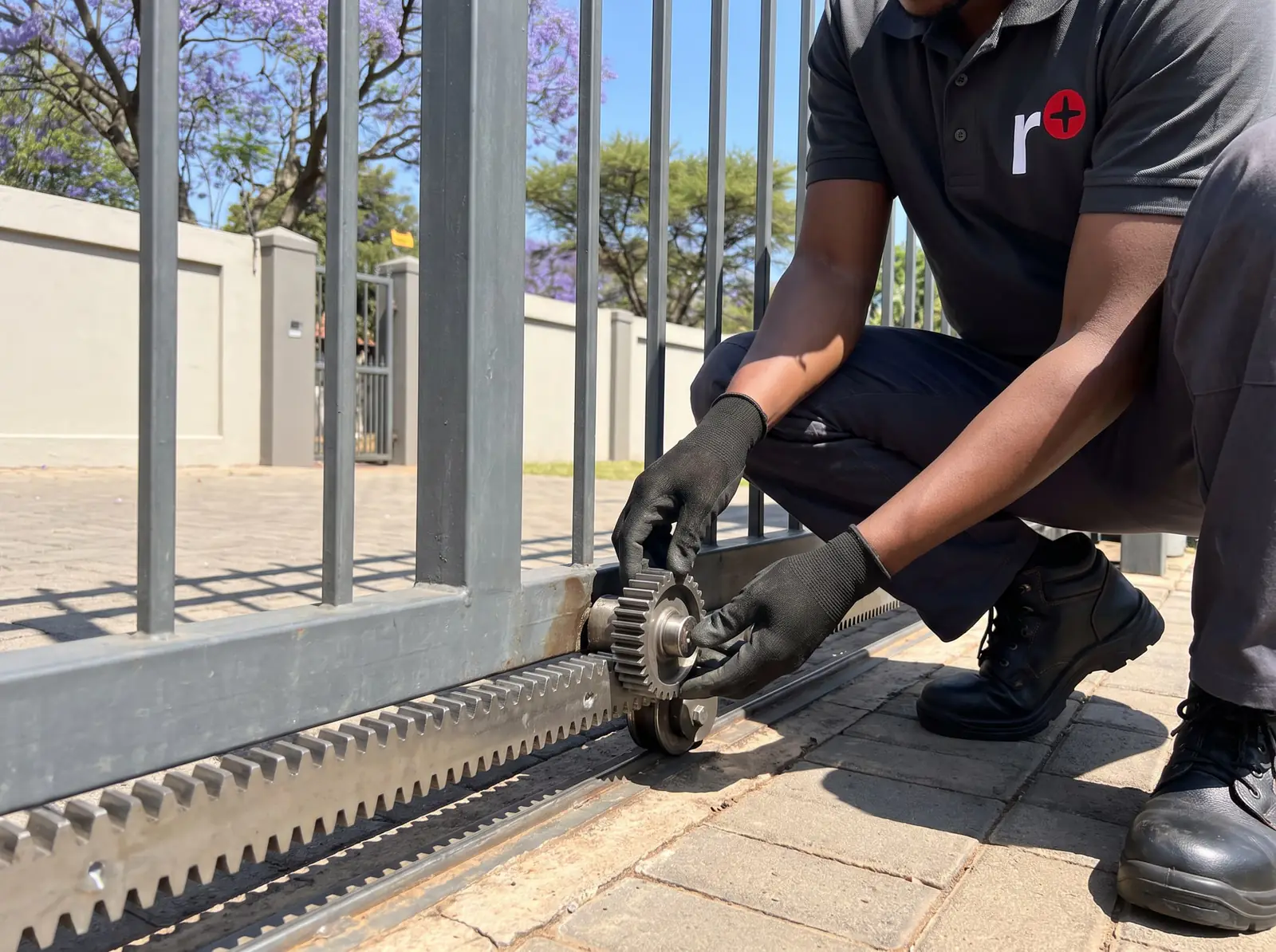
- the rack pressing down too hard on the motor's pinion, often where two rack sections meet;
- on a swing gate, sagging hinges or a leaf scraping the paving.
The hand test: is it the gate or the motor?
This is the one test that tells you most:
- Release the motor with its key, as your installer showed you. Do it with the gate stopped.
- Push the gate by hand along its whole travel, slowly.
- Feel for a tight spot, a jolt where the rack joins, or a point where it wants to roll back.
- Look at the track and wheels for stones, sand or a bent section, and sweep the track clean.
- Lock the motor again and try it.
If the gate is stiff by hand, the motor isn't the problem and turning up its force isn't the fix: that only makes it push harder on whatever is in the way, including a child or a car. The gate needs its wheels, track, guides or rack attended to. See sliding gate off its track if it has jumped the rail.
3. A battery that can't finish the job
A gate motor runs from its battery, which the mains only keeps charged. A worn battery can start the gate and then run out of push halfway, especially after load shedding or on a cold morning. Signs: the gate is slower than usual, worse after a power cut, and fine again later in the day. On an ET Drive motor the display shows Bat when the battery is flat, and ET suggests 8 to 10 hours on charge before judging it.
If the gate has been slow for weeks and the battery is a few years old, it's likely at the end of its life. More on gate motor batteries that won't charge.
4. A collision lock-out
If a gate meets resistance several times in a row without reaching either end, it stops trying. On ET's Drive motors, four collisions in a row lock the motor out: the display shows col (or Collision Timer on a Drive 1000) and it beeps while you hold the remote. The cure is the same on most makes: release the motor, clear whatever was in the way, check the gate runs freely by hand, then lock it again and try once.
If it locks out again straight away with nothing in the way, the gate is still dragging somewhere, or the motor has lost its settings, and it's time to book.
5. Swing gates and wind
Swing gates catch the wind like a sail, more so if they've been clad with sheeting or shade cloth since the motors went in. ET's Wingo manual lists cladding and a windy site among the things that make a swing motor work harder. On a gusty day, a clad leaf can push back hard enough for the motor to treat it as an obstruction and stop. If your swing gate only misbehaves in wind, that's very likely the cause, and the long-term fixes are stronger motors or less solid cladding.
6. Limits that have moved
The motor knows where to stop from its limit settings, a magnet or actuator on the rack, or a position it learnt. If a car has bumped the gate, the rack has shifted or the actuator has worked loose, the motor can stop early or look for the end in the wrong place. On ET's motors, e-l means the closed limit wasn't seen. Limits are reset with the setup routine in the manual, which is usually a technician's job: see how to set gate motor limits.
When to stop and call us
Call us when the gate is stiff by hand and you can't see why, when it locks out repeatedly, when the battery is new and it still stops, or when the motor makes grinding noises. Don't keep pressing the remote on a gate that keeps stopping: each attempt strains the motor and the gate. A gate stuck half-open at night is covered by our 24/7 emergency repairs across Gauteng. We repair the gate and the motor together, and every repair carries our six-month guarantee on our repairs. No call-out fee when we do the work. If no work is done, a R650 call-out fee applies.
Fault finder
Check why your gate stops or turns back
Pick what you're seeing for the likely causes, the safe checks you can do yourself, and when to stop and book. Taken from the manufacturers' own manuals.
What's it doing?
Likely causes
Gate motor · it starts closing, then opens again
Most likely first
Something breaks the safety beams as the gate closes.
The motor feels resistance and treats it as a collision: something on the rail, a stiff wheel, or the gate running badly.
Safe checks you can do
When to stop and book
If the path is clear and it still reverses, the collision settings or the beams need a technician.
From the official manuals: Centurion D5-Evo installation manual, Centurion D5-Evo and D10 user guide.
Questions
Questions about gates that stop halfway
Why does my gate open about a metre and stop?
Most likely the button you pressed is learnt to the pedestrian opening, which opens just wide enough for a person; on an ET Drive 300 that's 1,000 mm from the factory. Try a different remote or button. Read about the pedestrian opening.
Why does my gate stop and reverse?
Its collision sensing felt more resistance than expected, from something in the way or from a gate that has become stiff to push. Release the motor and push the gate by hand to find out which. See the hand test.
Should I increase my gate motor's force?
Not to cure a gate that stops: higher force makes the motor push harder against whatever is in the way, including a person. Fix the gate's wheels, track or rack instead. Read about resistance.
Book a technician
Get a gate motor quote
Job card
We WhatsApp or call you back. Fields marked (required) are needed.