Gates · Safety beams
Gate safety beams: fitted, aligned and repaired
Safety beams are the pair of small units on either side of your gate that stop it closing on a child, a dog or the back of a car. They're also the first thing to check when a gate refuses to close: a beam that's dirty, knocked or failing looks to the motor exactly like something standing in the way. Here's what beams do, the wired and wireless kinds we fit, how they're installed and aligned, how to check yours safely, how they double as an alarm, and what they typically cost.
Six-month guarantee on our repairs
10 years of experience in gate motor installation and repairs
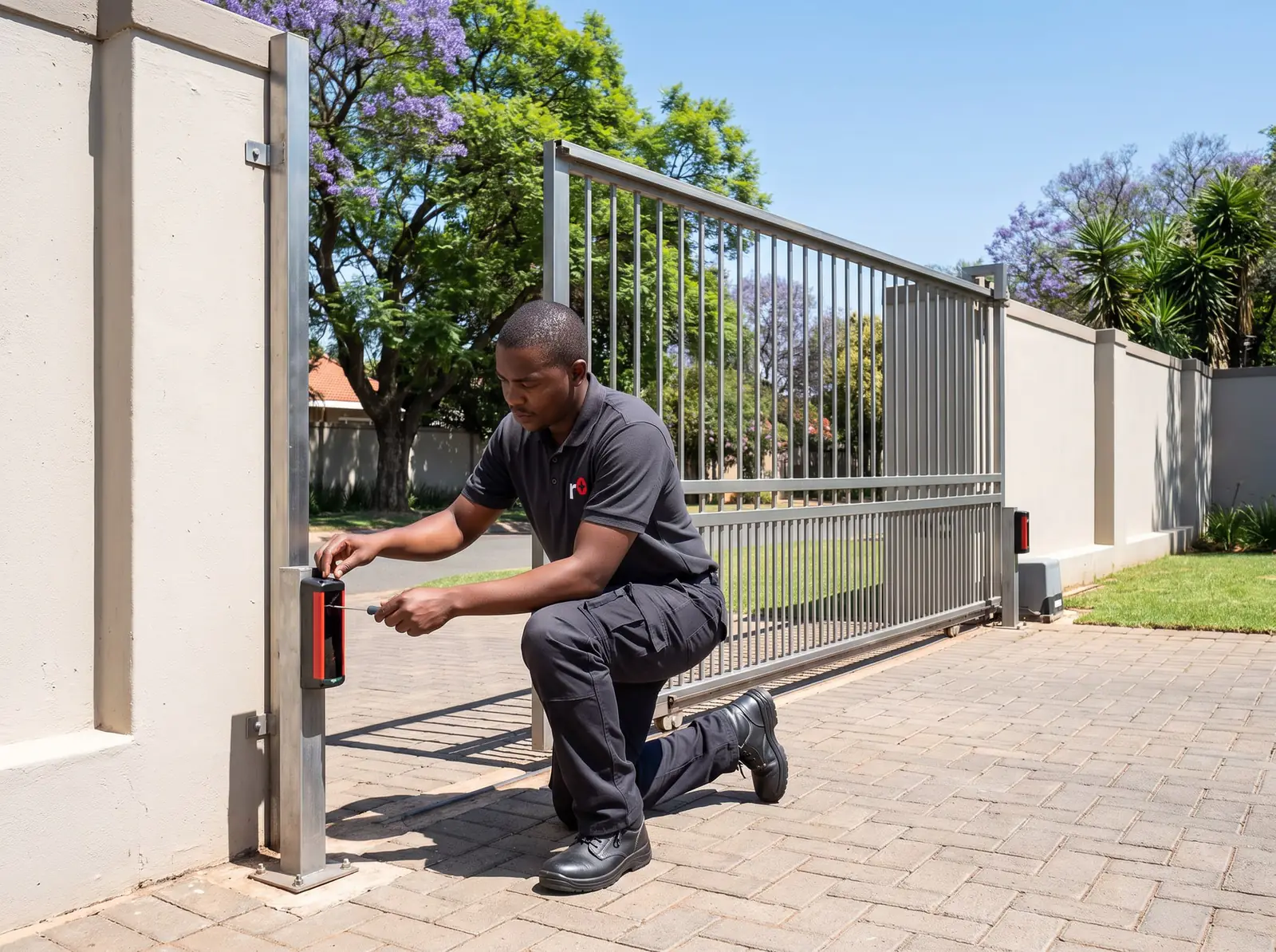
What safety beams do
A transmitter on one side sends an invisible infrared beam to a receiver on the other. While the beam arrives, the receiver tells the motor the way is clear; when something breaks it, the motor reacts. Centurion's user guide sets out how its D5-Evo and D10 respond:
| Beam | Gate open or closed | Gate moving |
|---|---|---|
| Closing beam broken | An open gate can't close | A closing gate stops and opens again |
| Opening beam broken | A closed gate can't open | An opening gate stops and closes again |
With auto-close on, the gate waits for a broken closing beam to clear, then closes once the timer has run. ET goes further: its Drive motors only close automatically with beams installed and working.
A ground loop is not a substitute. Centurion points out that a loop only senses large metal objects, such as cars, and gives no protection to people or anything else in the gate's path.
Wired or wireless beams
| Beam | Power | Range | Worth knowing |
|---|---|---|---|
| Centurion i5 | Wired, 12 to 30 V AC or DC, from the motor | Up to 40 m | A wide beam that's forgiving to align; works with Centurion's automatic beam test |
| Centurion Photon | Wireless transmitter on two AA alkaline cells, at least two years | Up to 30 m | Beeps when its batteries are low; no cable across the driveway |
| Centurion Photon SMART | Wireless, batteries over two years | Up to 30 m | For SMART controllers; low batteries show in the MyCentsys app |
| Gemini wireless IR beams | Battery transmitter, wired receiver | A button on the transmitter shows its charge as LED flashes | |
| ET Nice beams | Wired | Must match the controller's circuit, below |
Wired beams take their power from the motor, so there's no battery to change, but a cable has to get across the entrance, under or along the driveway. Wireless beams save that cable, which matters on a finished driveway, at the cost of a transmitter battery every couple of years.
The beam must also suit the controller. ET's wiring sheet shows three different circuits: end-of-line resistor monitoring on its Drive series, normally-open on the ET500, and normally-closed on the DC Blue Advanced. A beam wired the wrong way for the controller can read as permanently broken, or never broken at all.
How beams are installed
- Opposite each other, in line and level. The transmitter and receiver face each other across the entrance. Both i5 and Photon cast a wide beam, which gives some leeway, but Centurion stresses mounting them on surfaces that are close to parallel: a small angle at the wall becomes a big miss across a wide driveway.
- At the right height. Centurion recommends 750 mm, adjusted to suit the site.
- Wired to the right terminals, with the beam's power from the motor's supply. For Centurion's automatic beam test, which checks the beams before every gate cycle, the i5 transmitter's negative goes to the controller's Safe Common terminal. Photon wireless beams can't use that test.
- Aligned. The i5 receiver's green LED lights when the beam arrives. The Photon has an installer mode, entered by holding its button for a second: two beeps, then the buzzer and red LED guide the alignment. Gemini's receiver uses a buzzer the same way. Over long distances Centurion notes the i5's cover may need to be on to align it.
- Tested. With the gate moving, something passed through the beam should stop it straight away. Centurion's Photon test listens for the receiver's relay clicking as the beam is broken.
Beams should be fitted on both sides that matter: closing beams across the entrance, and opening beams where a sliding gate runs back along the wall, if anyone could be caught there.
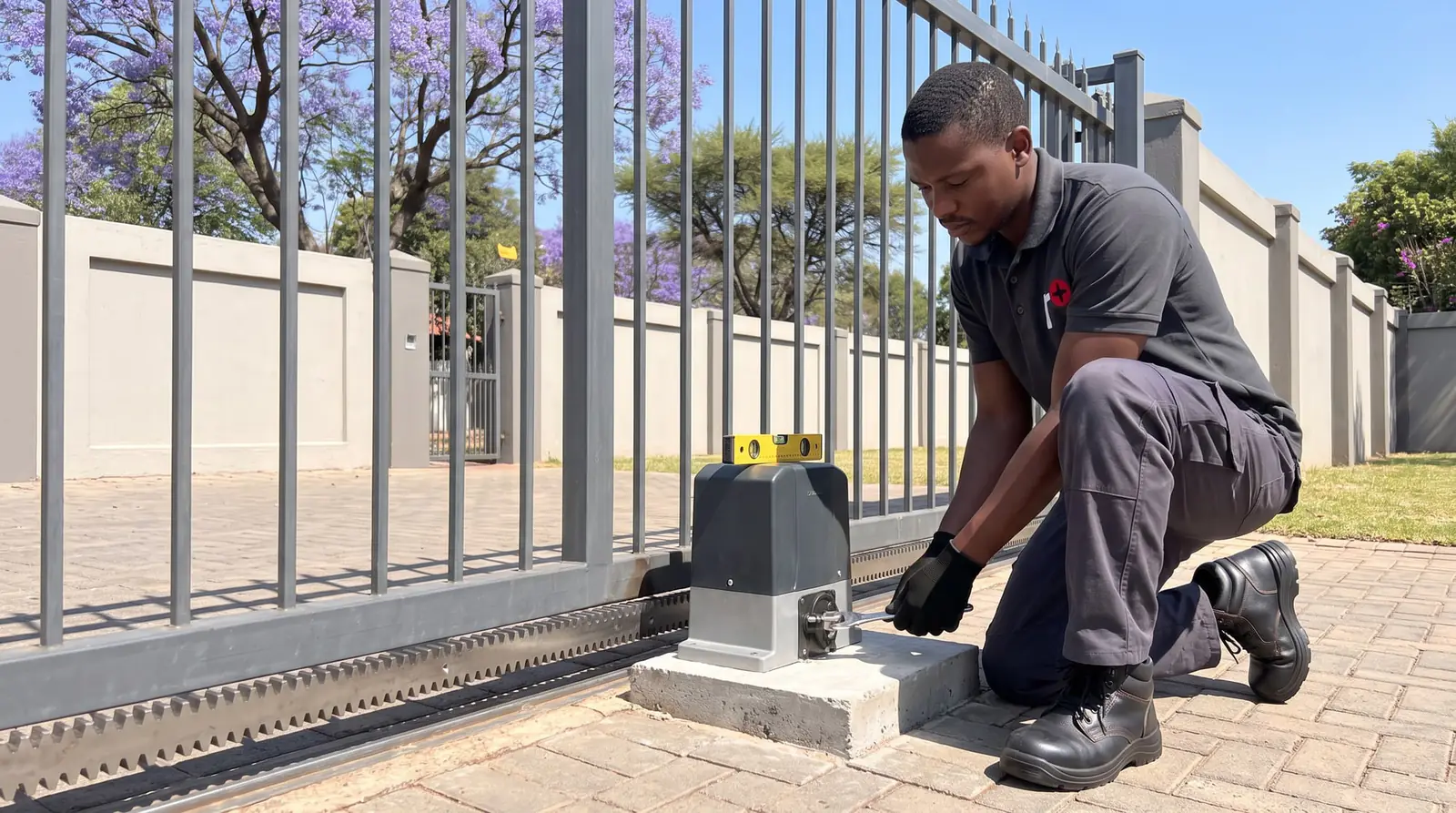
How to check your beams
These checks are safe for anyone to do:
- Look along the line between the two units for a bin, a plant, a parked car's bumper or a long grass stem.
- Clean the lenses with a soft, dry cloth. Spider webs and dust can be enough to break the beam.
- Read the lights. On an i5, the receiver's green LED should be on. On a Photon, the receiver's red LED stays off when the beam is getting through, and flashes once a second when it's blocked.
- Check the wireless batteries. A Photon transmitter beeps when its batteries are low; they take alkaline AA cells only, never rechargeables. On a Gemini wireless beam, press the transmitter's button and count the flashes: two means full, eight means empty.
- Test it safely. With the gate closing, pass a cardboard box through the beam, never a person or a pet. The gate should stop and open again.
If a unit has been knocked out of line, leave it and tell us: forcing it can crack the housing or the post. Gates that won't close because of their beams are covered step by step in gate not closing.
Why we never bypass beams
A gate whose beams keep failing is frustrating, and "bridging" them so the motor thinks they're clear is a common request. We don't do it. Without beams, the only thing between a closing gate and a person is the motor's collision sensing, and Centurion only allows its strongest force setting, with collision sensing switched off, where beams and safety edges are fitted. ET's Drive won't auto-close without them at all.
If the beams have failed and the gate must be secured, close it by hand with the motor released, as its manual shows, and lock the release again. Then call us to find the fault.
Beams as an alarm
On Centurion's D5-Evo and D10, the beams can also guard the gate:
- Ambush alarm. Centurion notes that intruders sometimes cover the beams' lenses to stop a gate closing behind you. If the beams stay broken for a set time, the alarm sounds.
- Break-in alarm. If the closing beam on the street side is broken, the alarm sounds, and carries on until 30 seconds after the beam is clear.
The controller can also be set to treat the opening beam as a closing beam while the gate closes. These are settings at the controller, which we set up when we fit or service the beams. More on securing the motor itself is on anti-theft brackets.
What safety beams typically cost
- Safety beams replaced: R600–R1 200 (Kandua)
- beams supplied and fitted R750–R1 500 (Kandua installation guide)
- Easy jobs (remote programming, battery, beam alignment) incl. call-out and parts: R500–R1 200 (Kandua)
- In shops, the beams alone: ET Blue Eyes about R570 (Takealot), Centurion i5 about R650 (Takealot), Photon about R900–R1 050 (Takealot)
These are the market's prices, not ours. Prices checked October 2026. With us, no call-out fee when we do the work. If no work is done, a R650 call-out fee applies. The installation matters as much as the beams: a wired beam's cable has to get across the entrance, which on a paved or concrete driveway means a channel, while a wireless beam avoids it. More on gate repair costs is on gate motor repair cost.
Getting beams fitted or repaired
Tell us the motor's make, whether there are beams already, and what the gate is doing. We supply and fit wired and wireless beams, align and test them, replace failed units and batteries, and set up the beam alarms where the controller has them. All our spare parts are genuine, and every repair carries our six-month guarantee on our repairs. Your exact price is set in a free quote before any work starts. No call-out fee when we do the work. If no work is done, a R650 call-out fee applies.
Questions
Safety beam questions
How to install safety beams?
Mount the transmitter and receiver opposite each other across the entrance, level and on near-parallel surfaces, at about 750 mm, wire them to the motor's beam input and supply, then align and test them. The wiring has to suit the controller. See how they're fitted.
How do I check my gate safety beams?
Clear anything between the units, clean both lenses, and look at the receiver's light: an i5's green LED should be on, and a Photon's red LED should be off. Test by passing a box through the beam as the gate closes; it should stop and reopen. See the checks.
How high should gate safety beams be?
Centurion recommends 750 mm above the ground for its i5 and Photon beams, adjusted to suit the site. Both units must sit at the same height, level with each other. See the installation steps.
Book a technician
Get a gate motor quote
Job card
We WhatsApp or call you back. Fields marked (required) are needed.