Gates · Boom gates
Boom gate installation and repairs
A boom knocked off by a delivery van, an estate entrance that needs to handle a morning queue, a car park that should let cars out without a ticket: we install and repair boom gates for estates, complexes, offices and car parks across our areas.
Six-month guarantee on our repairs
24/7 emergency repairs across Gauteng
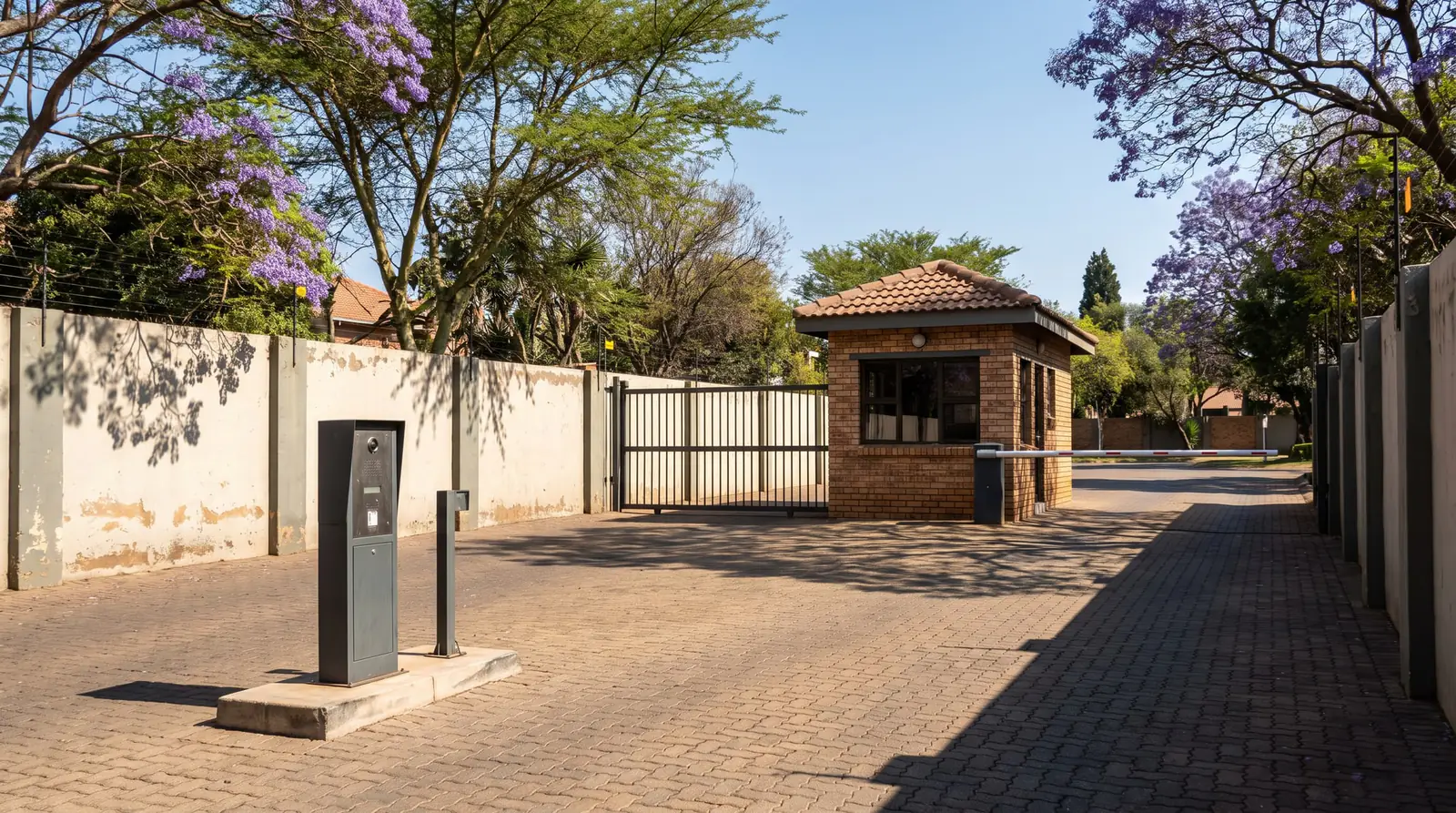
What a boom gate is
A boom gate, or traffic barrier, is a single arm that swings up to let a vehicle through and down to stop the next one. "Boom" is the old word for a long pole or spar, and that's exactly what the arm is. Booms are made for controlling vehicles: they open in a second or two, run all day, and work with intercoms, keypads, remotes, tag readers and ticket machines.
What a boom doesn't do is stop people on foot. So at an estate or a business, a boom usually works alongside a sliding gate for security after hours, or a pedestrian gate with its own access control.
Pole lengths and speeds
Booms come sized to the width of the road they close. Centurion's Sector II, for example, comes in three models:
| Model | Longest pole | Raise time (adjustable) |
|---|---|---|
| Sector II 3 m | 3 m | 1.2 seconds |
| Sector II 4.5 m | 4.5 m | 3 seconds |
| Sector II 6 m | 6 m | 3 seconds |
The model's number is the longest pole its spring is built to balance. Centurion is clear that a 4.5 m pole needs the 4.5 m or 6 m model with the matching spring; a long pole on a short-pole spring is out of balance and wears the motor. A replacement pole has to be the same length as the one the boom was set up for, or the spring has to change with it.
Built for traffic
The reason estates and car parks use booms is how much they can do in a day. The Sector II is designed for up to 3,000 operations a day, with a duty cycle of 80%, which Centurion explains as 48 minutes of running in every hour. It runs from a 12 V battery, 7 Ah as standard and larger for longer standby, kept charged from the mains, and Centurion notes it can run from solar.
How a boom installation is laid out
Most of the work in a good boom installation happens before the boom arrives. ET's installer manual for its Access Blue boom sets out the order, and it's how we plan any boom:
- Trench and conduit first. Every cable, for the intercom, keypad or tag reader, the loops, the beams and the power, is laid in conduit before the plinth is cast, because the cables come up through the base and no holes should be cut in the sides.
- A raised plinth. The plinth is cast above road level, so rainwater doesn't dam around the base.
- The safety loop in the right place. ET puts the presence loop halfway between the entry and exit sides of the pole, and halfway along its length, so the boom doesn't react to itself.
- Beams for tall vehicles. Safety beams protect the area under the pole; where trucks or high vehicles use the entrance, ET recommends two beam receivers, wired together.
- Free exit that doesn't fight the entry. Where a loop lets cars out without a remote, it's wired so the boom closing behind an incoming car doesn't reopen as that car rolls over it.
- Long cables handled properly. On cable runs longer than about 10 m, ET advises a relay at the far end, to stop induced voltages triggering the boom.
The mains supply to the plinth is a job for a registered electrician, done to the local council's wiring rules.
Loops: how a boom senses cars
An inductive loop is a coil of wire cut into the road surface, connected to a loop detector that notices the metal of a car above it. Centurion's FLUX SA detector lists the jobs a loop does at a barrier:
- Free exit: opens the boom for a car leaving, with no remote needed.
- Safety: keeps the boom up while a car is under it.
- Closing: lowers the boom once the car has passed.
- Arming: readies an access device only when a car is actually there.
The FLUX SA adapts to changing conditions on its own, which cuts out false triggers. Loops are cut into the road, so road works and resurfacing are their main enemy; a cut loop shows up as a boom that won't open for exiting cars, or won't close.
Remotes, keypads and intercoms
A boom is only as convenient as the way people open it. The Sector II's built-in receiver holds 500 remote buttons, enough for most complexes, and booms work with intercoms, keypads, tag readers and ticket machines through their trigger inputs. For a complex, residents usually use remotes or tags and visitors the intercom; our intercom and gate remotes pages cover those.
When the power goes
Out of the box, the Sector II is fail-safe: its pole moves by hand, no tool needed. Some sites have it set to lock mechanically, and then a 6 mm Allen key, used from outside the housing, overrides it. A third option has the boom lift itself when the mains fails and stay up until the power is back, for an exit that must never trap cars inside. How it should behave is a decision for the estate or business, made when it's installed.
Boom gate repairs
The repairs we're called for most are the predictable ones: a pole knocked off or bent by a vehicle, a loop cut by road works, beams knocked out of line, a battery that no longer carries the boom through a power cut, and remotes, keypads or intercoms that have stopped talking to it. Replacing a pole is usually quick, provided the new one is the right length for the spring. All our spare parts are genuine, and every repair comes with our six-month guarantee on our repairs.
What boom gates cost
Barriers in South African shops, typical figures, not ours:
- 3 m DC barrier, 430 stainless, loop detector and boom pole: about R32 000 (NeonSales)
- 4.5 m, same specification: about R33 900 (NeonSales)
- 6 m, same specification: about R36 000 (NeonSales)
- Replacement boom pole, 3 m rectangular: about R3 240 (NeonSales)
Installation has no reliable published figure, because every site differs: the plinth, the loops cut into the road, the cabling, and the access control. We price it on site. Prices checked October 2026. Your exact price is set in a free quote before any work starts. No call-out fee when we do the work. If no work is done, a R650 call-out fee applies.
Booking a boom gate technician
On the job card, tell us whether it's a new installation or a repair, the width of the road, how many cars use it a day, and what access control you have or want; a photo of the entrance helps. Same-day repairs are offered for repairs when the day allows, and a boom stuck down or knocked off at a busy entrance is treated as urgent.
Fault finder
What is your boom or gate doing?
Pick what you're seeing for the likely causes, the safe checks you can do yourself, and when to stop and book. Taken from the manufacturers' own manuals.
What's it doing?
Likely causes
Gate motor · it's beeping
Most likely first
The mains power to the motor is off, so it's running on its battery. Centurion and Gemini motors give two beeps (or two flashes) in a row; an ET Drive flashes twice and gives a one-second beep every 15 seconds.
The battery is low. Centurion and Gemini motors give three beeps in a row; an ET Drive's status light flashes four times, without a beep.
Something is between the safety beams. A Centurion motor gives a single beep every so often and won't close.
The gate has hit something several times in a row, so the motor has stopped to protect itself. A Centurion keeps beeping until that's cleared.
A holiday lockout or a time setting is blocking the remote: the motor beeps once when you press it and the gate doesn't move.
On a Gemini, four beeps as the motor starts means the manual release lever isn't fully engaged.
Safe checks you can do
When to stop and book
If it keeps beeping with the power on and the beams clear, the battery, charger or controller needs a technician. Don't open the motor: Centurion warns that work by anyone unauthorised may void the manufacturer's warranty.
From the official manuals: Centurion D5-Evo and D10 user guide, ET Drive 500 and 600 user manual, Gemini 24V DC slider manual.
Questions
Boom gate questions
Why is it called a boom gate?
"Boom" is an old word for a long pole or spar, and the gate is exactly that: one long arm that swings up and down. Read more.
What is a boom gate?
A barrier with a single arm that lifts to let a vehicle through and lowers behind it, built for heavy traffic and linked to remotes, intercoms, keypads or tag readers. Read more.
What is the purpose of a boom gate?
To control vehicles at estates, complexes, offices and car parks quickly and all day. It doesn't stop people on foot, so it's usually paired with a gate or a pedestrian entrance. Read more.
How much does it cost to install a boom gate?
A Centurion Sector II barrier sells for about R26 200 (3 m, mild steel) to about R36 000 (6 m) in South African shops; installation depends on the plinth, loops, cabling and access control, so it's priced on site. See prices.
What is the price of a 6 meter boom barrier?
A 6 m Sector II with a loop detector and boom pole sells for about R36 000 in South African shops, before installation. See prices.
How much does it cost to replace a boom gate pole?
A 3 m rectangular replacement pole sells for about R3 240; it must match the length the boom's spring was set up for. Read about poles.
Book a technician
Get a gate motor quote
Job card
We WhatsApp or call you back. Fields marked (required) are needed.