Garage doors · Hardware
Garage door cable repair, rollers and tracks for sectional doors
Behind every sectional garage door is a set of hardware that does the real work: cables that lift it, rollers and hinges that let its panels bend round the curve, and tracks that guide it up and back. When any of it wears, the door gets noisy, jerky or crooked, and the motor starts to strain. Here's what each part does, the signs it's failing, what you can safely check, what the repair involves and what it typically costs.
Six-month guarantee on our repairs
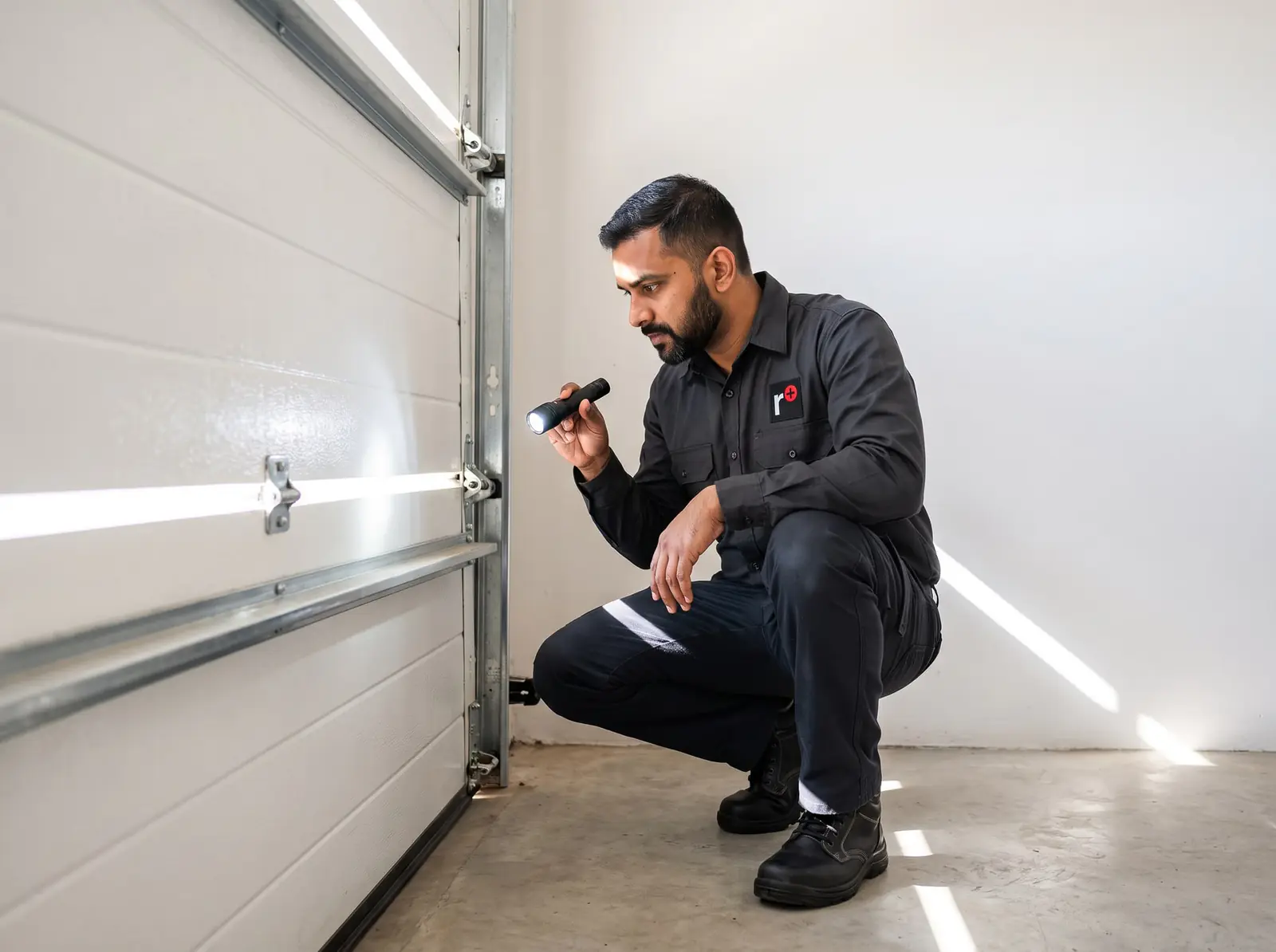
The hardware, part by part
| Part | What it does | When it fails |
|---|---|---|
| Lift cables | Steel cables from drums on the spring shaft to the door's bottom corners; they lift the door as the shaft turns | Fray, rust, stretch or snap; jump off the drum when they go slack |
| Drums | Grooved wheels on the shaft that wind the cables on evenly | Wear or crack, letting the cable slip |
| Bottom brackets | Hold the lowest rollers and anchor the cables | Rust or bend, especially near the floor |
| Rollers | Small wheels on the panel edges that run in the tracks | Wear flat, seize or lose their bearings, so the door judders and drags |
| Hinges | Join the panels so the door can bend round the curve | Crack or wear their pins, letting panels sag |
| Tracks | Guide the rollers up the sides and back under the ceiling | Bend when hit, work loose, or go out of line |
These parts carry the door's weight under the springs' tension, which is why Hydro Doors' Digidoor manual describes doors, springs, cables, pulleys and brackets as being under extreme force.
Signs the hardware is failing
- Grinding, squealing or clunking as the door moves, often a worn or seized roller.
- The door judders or catches at the same point each time, often at the curve. Centurion's SDO4 manual names a jump where the curve meets the straight as a fault to fix before a motor is fitted.
- One side lifts before the other, or the bottom edge isn't level when closed: a stretched or slipping cable, or a worn drum.
- A cable looks frayed or rusty, or hangs slack beside the door.
- A panel sags at a joint, or a hinge has cracked.
- A track is bent, loose or out of line, after a car has touched it or a fixing has worked loose.
- The motor strains, stops or reverses. Hydro Doors is clear that its opener isn't meant to make up for a door that binds: the door has to be right first.
A door showing these signs is worth stopping before it gets worse. A failing cable or roller can let the door come off its track, which is a far bigger job than the part that started it.
What you can safely check
- Look, don't touch, at the cables and drums above the door, and at the bottom brackets at each corner. Fraying, rust and slack are visible from the floor.
- Watch the rollers as the door runs: each should turn, not slide or wobble.
- Look along the tracks for bends, loose bolts, and dirt or debris in the channel.
- Keep the tracks clean, and don't grease them. Gemini's manual asks for the channels to be cleaned with a stiff brush and never greased, ET's says never to lubricate the door tracks, and Hydro Doors wants a roll-up door's side tracks free of grease and dirt. Grease in a track collects grit.
- Check the balance with the motor released the way its manual shows: Centurion's guide is no more than 10 kg to move the door by hand, and no more than 100 mm of drift when it's let go halfway.
Don't loosen a bracket, unhook a cable or try to lift a roller back into its track. Every one of them is holding spring tension.
What the repair involves
- Make the door safe: support its weight and take the tension off the cables before anything is undone.
- Replace worn parts in sets. Cables are normally replaced in pairs, and rollers and hinges are worth doing together where several are worn, so the door runs evenly.
- Straighten or replace damaged track, then set it level, plumb and correctly spaced, with the fixings tight, as both Centurion and Hydro Doors ask.
- Check the drums and bottom brackets, which a failed cable has often been rubbing against.
- Balance the door and test it by hand, then on the motor, resetting the motor's limits if they need it.
ET's sectional installation manual adds a reminder of why this is never a quick bodge: everything the motor and door hang from has to be strong enough to hold the door if a balancing spring snaps.
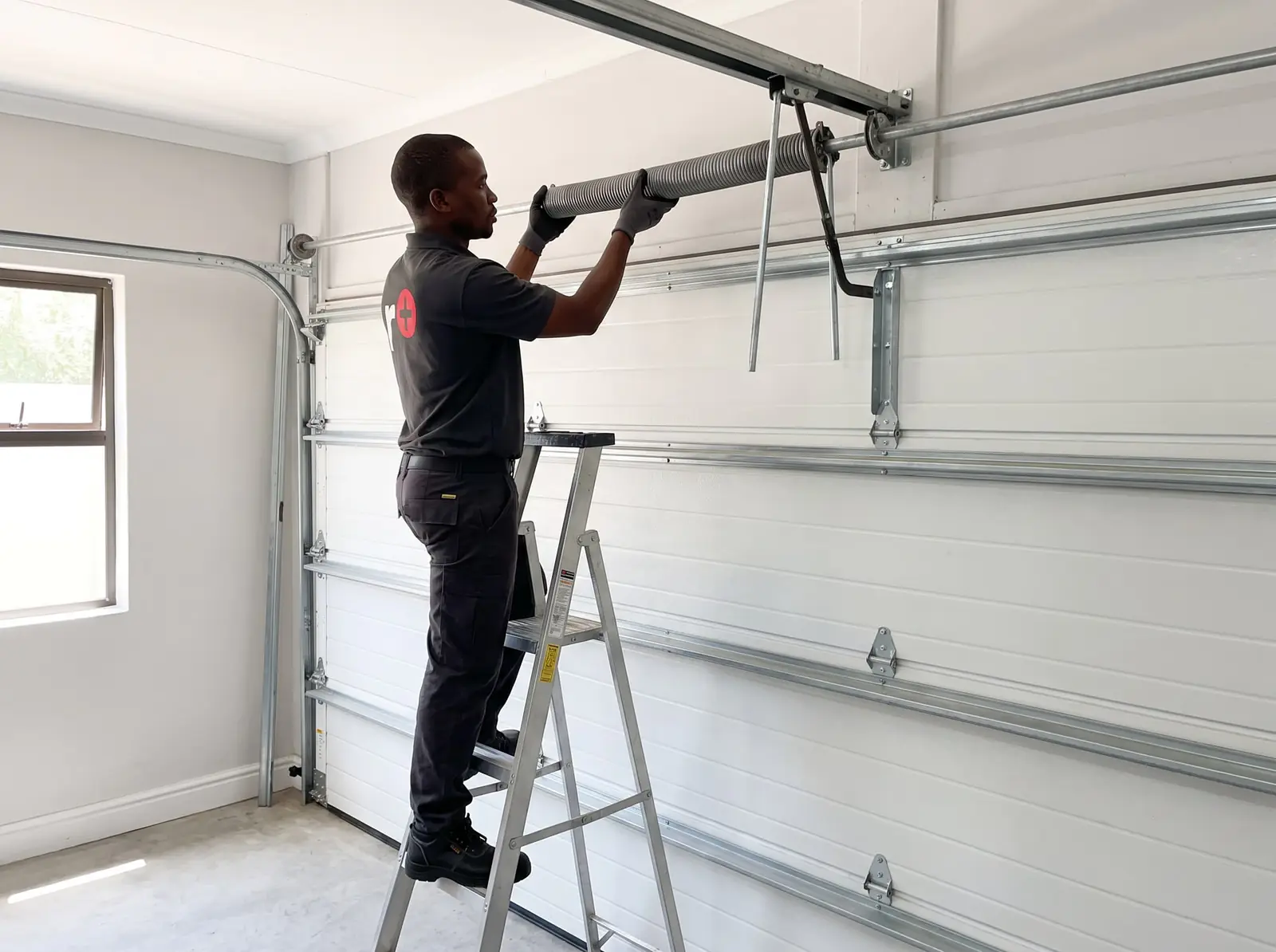
What cable and hardware repairs typically cost
- Cable replacement: R700–R1 600 (published price lists of Gauteng installers)
- Spring, cable or motor component repair: R1 200–R4 000 (Handld); typically about R2 200 (Handld)
- Garage door service: R650–R950 (published price lists of Gauteng installers)
- Call-out and inspection: R450–R750 (published price lists of Gauteng installers); R350–R800 (Kandua)
These are typical market prices, not ours. Prices checked October 2026. With us, no call-out fee when we do the work. If no work is done, a R650 call-out fee applies. Spring prices, which often come into the same job, are on garage door spring replacement cost.
Getting it fixed
Send us a photo of the door, the cable or part that's failing and the motor. We replace cables, drums, rollers, hinges, brackets and tracks on sectional doors across our areas, Sandton and the northern suburbs included, balance the door and check the motor while we're there. When a cable has come off its drum, see garage door cable came off drum first, and for the whole door, sectional garage doors. All our spare parts are genuine, and every repair carries our six-month guarantee on our repairs. Your exact price is set in a free quote before any work starts. No call-out fee when we do the work. If no work is done, a R650 call-out fee applies.
Questions
Cable, roller and track questions
How do I get my garage door roller back on track?
Don't force it: the roller is carrying part of the door's weight under spring tension, and the door can drop or twist as it comes free. Stop using the motor, keep clear of the door and call us; we take the weight off before refitting it. See what you can check.
Can I replace a garage door cable myself?
No. The cable is held tight by the door's springs, and taking it off means releasing that tension safely. Hydro Doors warns that cables and springs are under extreme force, and ET leaves spring work to qualified people. See what the repair involves.
How much does it cost to replace a broken garage door cable?
On typical market figures, a cable replacement comes to R700–R1 600, with both cables normally done together. Prices checked October 2026. See typical costs.
How much does it cost to replace a garage door cable?
It depends on what else is worn: the cables alone, or the cables with drums, springs or brackets. Handld's guide puts spring, cable or motor component repairs at R1 200–R4 000; typically about R2 200. Prices checked October 2026. See the repair.
Is it easy to replace garage door rollers?
Not on your own: the lowest rollers sit in the bottom brackets, which also anchor the lift cables under spring tension, and changing the others means taking the door's weight. It's a job for a technician, with the door made safe first. See the steps.
How do I know what size garage door rollers I need?
Match the old ones: the wheel has to suit the width of your door's track, and the stem has to fit the hinges and brackets. A photo of an old roller beside a tape measure, or the roller itself, is the surest guide. See the hardware table.
Is it worth replacing garage door rollers?
Yes, when they're worn: rollers that drag or judder make the door bind, and Hydro Doors asks for worn rollers, hinges and bushings to be replaced because its opener isn't meant to fight a binding door. See the signs.
Book a technician
Get a garage door quote
Job card
We WhatsApp or call you back. Fields marked (required) are needed.