Guides · Gate motors
Lithium gate motor battery or lead-acid: the best choice for load shedding
Load shedding is hard on gate motor batteries: they're drained every evening and recharged in the gaps, and a battery that would last years on a quiet street can be finished in months. So is a lithium battery worth it, or a bigger lead-acid one, or neither? It depends on your motor and your street. Here's how to decide, using the makers' own figures.
Six-month guarantee on our repairs
1-year guarantee on every motor kit we supply and install
Start with what your motor was designed for
The first rule is the voltage. A motor built for a 12 V battery needs 12 V, and a 24 V motor needs 24 V, whether from one battery or two in series. The standard fit, from the makers' own documents:
- Centurion D5-Evo: one 12 V 7 Ah sealed lead-acid battery.
- Centurion D10: two 12 V 7.2 Ah batteries.
- ET Drive 500 and 600: one 12 V 7 Ah.
- ET Drive 300: a 24 V, 3.5 Ah pack.
- ET Drive 1000: 5 Ah as standard, or two 3.5 Ah for more openings.
- Gemini 12 V slider: a 12 V sealed lead-acid of 7 or 12 Ah, and Gemini lists the motor as lithium compatible.
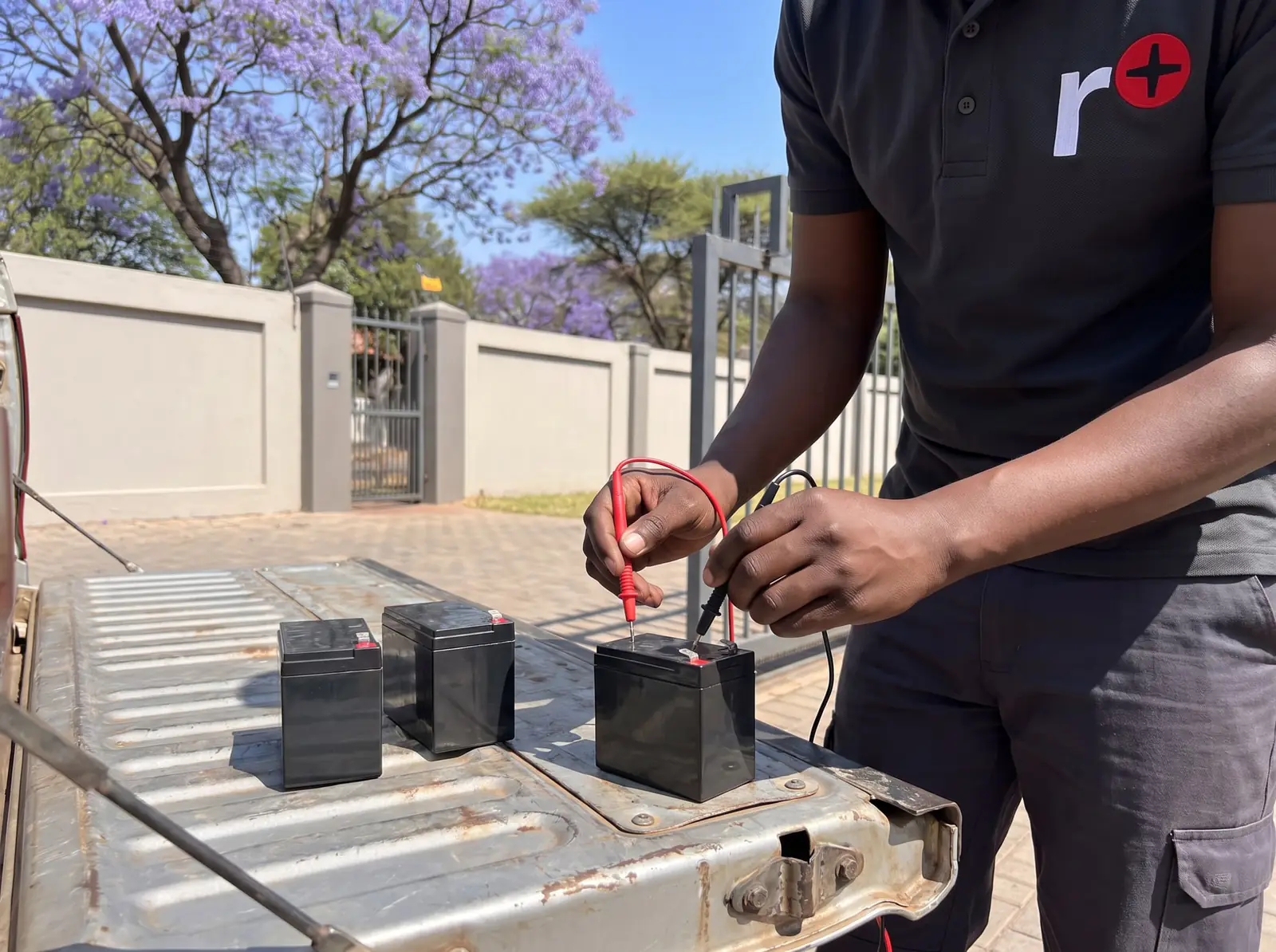
If you're not sure what's in yours, the label on the battery tells you. A photo of it sent with your booking lets us bring the right one.
What actually decides how long the gate keeps going
In a power cut, the number of times the gate opens depends on more than the battery:
- How healthy the battery is. Makers' figures assume a good battery, fully charged when the power went off. A three-year-old battery that's been cycled every night gives a fraction of that.
- How easily the gate moves. A gate that drags uses far more current per opening.
- What else runs from the motor: beams, keypads, intercoms and receivers all draw from the same battery.
- Whether it recharges between outages. Two cuts close together, with too little mains time between them, leave the battery starting the second one half empty. ET's advice after a low-battery warning is 8 to 10 hours of uninterrupted charge.
For scale, ET quotes about 100 openings in 24 hours after a failure for the Drive 500 and 600 on an easy-running gate, and Centurion's D5-Evo figure is 35 over a full day with its standard battery. Fixing a stiff gate often does more for load shedding than any battery.
Option 1: a bigger lead-acid battery
The simplest upgrade is more capacity at the same voltage. Centurion notes that a larger battery gives a longer standby time, and its D10 figures show how much: two 7 Ah batteries manage 87 operations over half a day, while a 35 Ah battery takes that to 507.
The catches are practical: a bigger battery must fit the motor's housing or sit in a separate box beside it, and the motor's charger has to be able to recharge it in the time you have between outages. A very large battery on a small charger may never fully recharge on a heavy load-shedding schedule.
Option 2: lithium (LiFePO4)
Lithium iron phosphate batteries are sold as upgrades for gate motors. Their advantages are real: they're lighter, they tolerate being run down deeply far better than lead-acid, and they keep more of their capacity over many cycles, which is exactly what load shedding demands.
The catch is the charger. Lithium needs a charger that suits its chemistry, and not every motor's built-in charger does. Some makers say so outright, as Gemini does for its 12 V slider; others specify lead-acid only. The same goes for other equipment: JVA's manual for its Z-series fence energizers, for example, calls for a 12 V sealed lead-acid battery and nothing else. So a lithium battery is a choice to make with your exact motor in mind, sometimes with a suitable charger added, not a straight swap.
Which is best for you?
| Your situation | What usually makes sense |
|---|---|
| Battery under 2 years old, gate works through most outages | Keep it; check the gate runs freely |
| Battery dying every year or two from nightly cycling | Lithium, if your motor or a matching charger supports it |
| Motor specifies lead-acid only | A larger lead-acid battery, if it fits and the charger keeps up |
| Busy gate, many openings in the evening outage | Lithium or a larger battery, plus a gate that runs freely |
| Long outages and a gate that must work regardless | A larger battery, or solar or backup power |
Whatever you choose, have the charger checked at the same time. A new battery on a faulty charger fails just as fast as the old one.
What each option typically costs
- 12 V 7 Ah lead-acid battery, supplied and fitted: R450–R900 (Kandua); in shops R230–R450 (generic to Centurion-branded; Takealot)
- Lithium (LiFePO4) battery upgrade, supplied and fitted: R1 500–R3 500 (Kandua); in shops about R550–R630 (Takealot)
These are the market's figures, not ours. Prices checked October 2026. Centurion says its maintenance-free batteries should give at least three years of normal service; heavy load shedding shortens that, which is what makes the extra cost of lithium worth weighing. Your exact price is set in a free quote before any work starts. No call-out fee when we do the work. If no work is done, a R650 call-out fee applies.
Getting it fitted
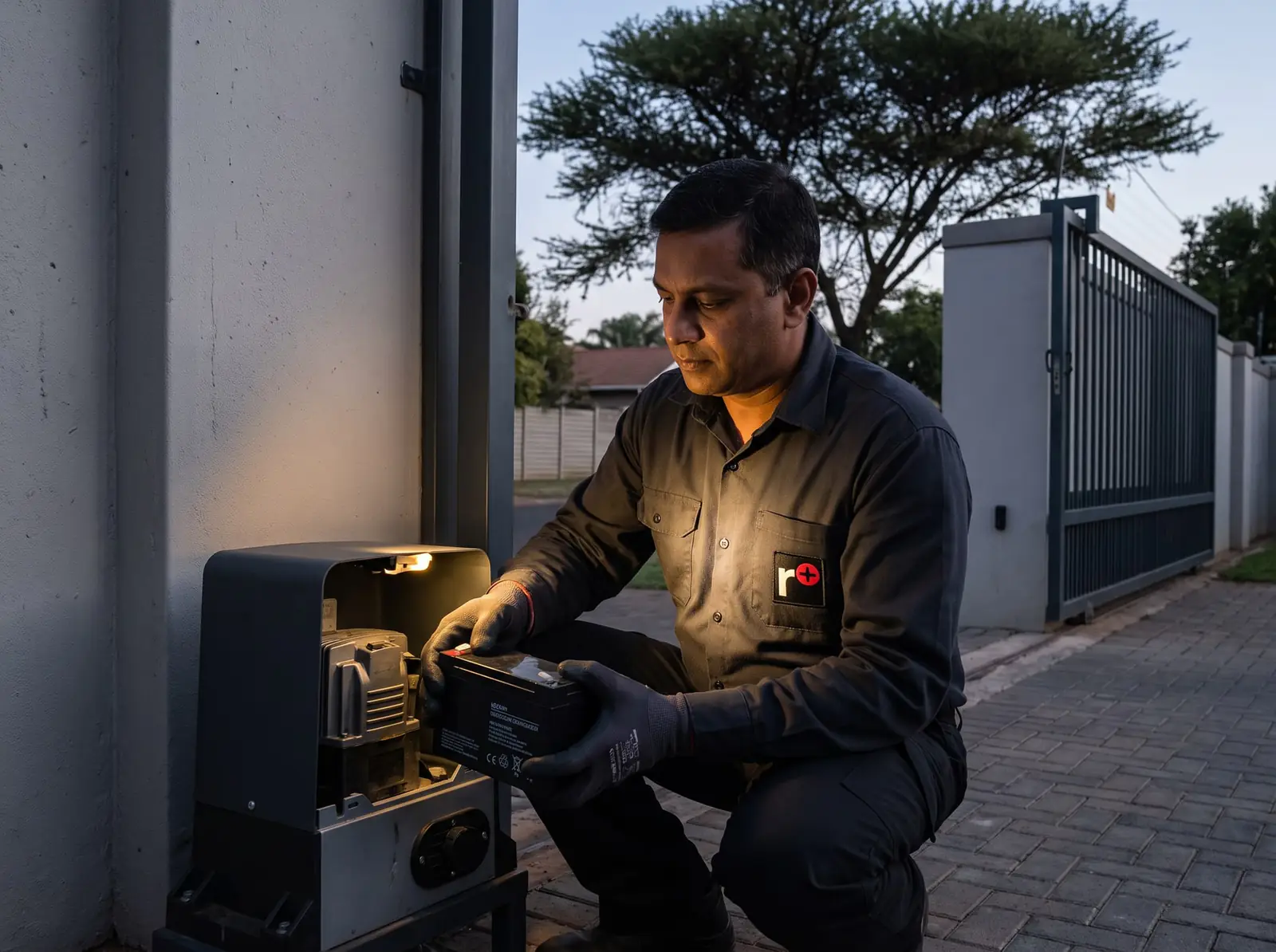
We test the old battery and the charger first, so you only replace what has actually failed, then fit the battery your motor can charge properly and test the gate through a full cycle on battery. All our spare parts are genuine, and every repair carries our six-month guarantee on our repairs. No call-out fee when we do the work. If no work is done, a R650 call-out fee applies. More on batteries for each motor is on gate motor batteries.
Questions
Questions about the best gate motor battery
What type of battery is best for a gate opener?
The one your motor is designed to charge: usually a 12 V sealed lead-acid of 7 Ah or more, or a 24 V pack on some motors. Lithium lasts longer under daily load shedding, but only where the motor's charger, or an added charger, suits it. See which is best.
Which battery is best for a gate motor?
Match the voltage first, then choose capacity: a bigger lead-acid battery gives more openings if it fits and the charger keeps up, and lithium copes best with nightly deep discharges if your motor supports it. Start with your motor.
What is the best 12V battery for a gate opener?
A good-quality 12 V sealed lead-acid of at least the capacity your motor's maker specifies, or a 12 V lithium iron phosphate battery where the motor's charger suits it. A healthy gate matters as much as the battery. Read about lithium.
Book a technician
Get a gate motor quote
Job card
We WhatsApp or call you back. Fields marked (required) are needed.