Gates · Power
Solar gate repair near me: solar charging and backup power for gate motors
A battery-backed gate motor already runs from its battery, so a power cut doesn't stop it straight away. What decides whether your gate keeps working through a long outage, a run of load shedding, or on a property with no mains at the gate, is how that battery is charged and how big it is. Here's how gate motors are kept going: a bigger battery, solar charging, feeding the charger from the house's backup power, and protecting the battery itself, with the makers' own figures, and what we do when a solar gate stops working.
Six-month guarantee on our repairs
10 years of experience in gate motor installation and repairs
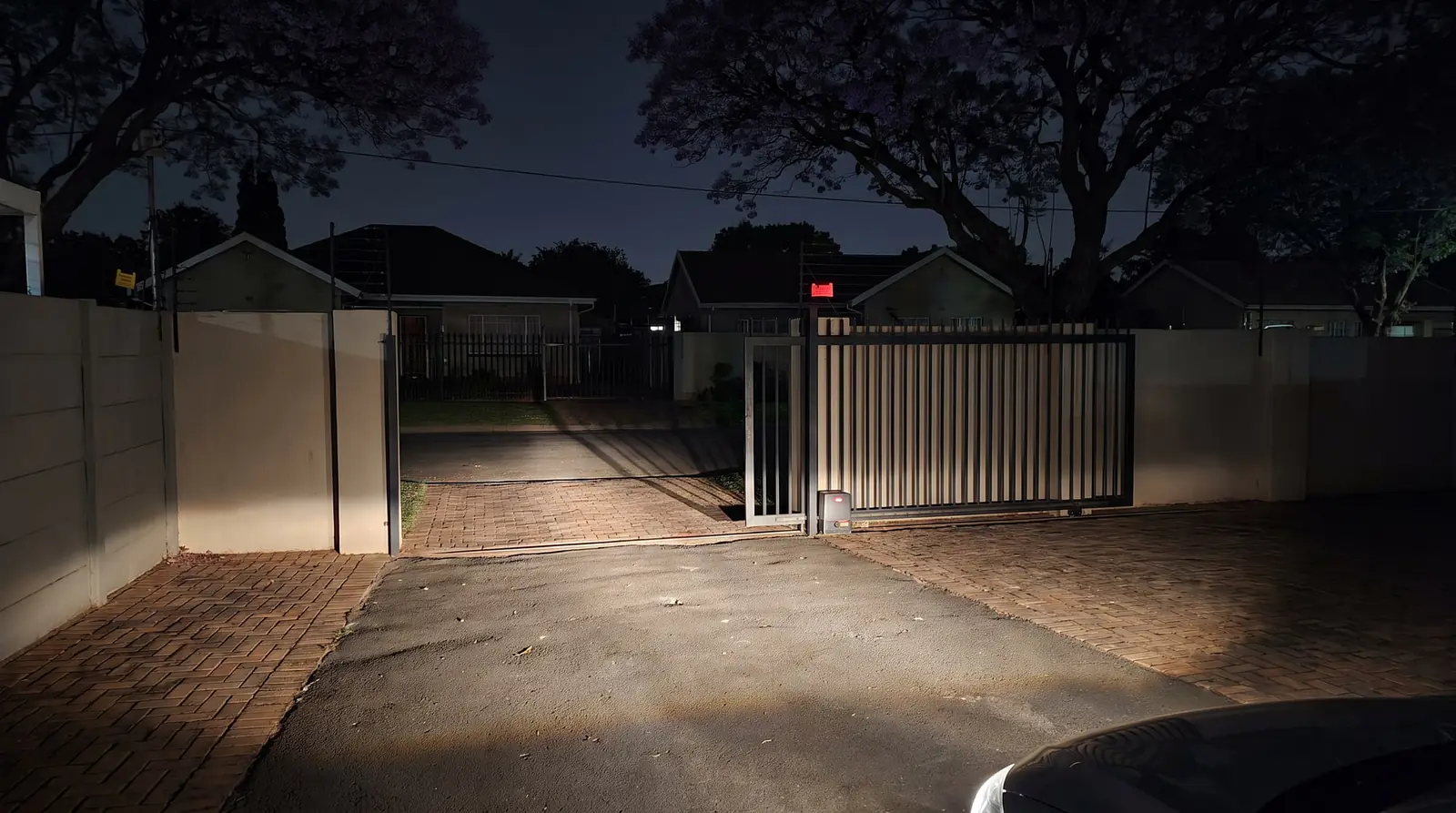
The ways to keep a gate going without mains
| Option | What it does | Best for |
|---|---|---|
| The motor's own battery | Runs the gate through an ordinary power cut | Every gate: it's standard |
| A bigger battery | More openings before it runs flat | Busy gates, long outages |
| Solar charging | A panel recharges the battery instead of, or as well as, the mains | No mains at the gate, or frequent outages |
| The house's backup power | Keeps the motor's charger running from an inverter or UPS | Homes that already have one |
| A battery saver | Disconnects a flat battery before it's damaged | Long outages on Centurion's D5-Evo |
The first is standard on battery-backed motors. The rest are worth adding when power cuts are long, back to back, or the gate is a long way from the house.
The battery comes first
Battery-backed motors, such as Centurion's D-series, ET's Drive and Gemini's DC sliders, don't run on mains: they run on their battery, and the mains only keeps it charged. When the power goes, the motor carries on until the battery is low, then protects itself and stops.
The simplest upgrade is more battery. Centurion notes that a larger battery gives longer standby, and on its D10 a 35 Ah battery multiplies the openings a power cut allows several times over. The voltage must match the motor, and the battery has to fit the housing and suit the charger. Which battery your motor takes, and how many openings each maker quotes, is set out on gate motor batteries.
A battery that's worn out won't be rescued by anything else on this page. If yours no longer gets the gate through a short outage, start by replacing it.
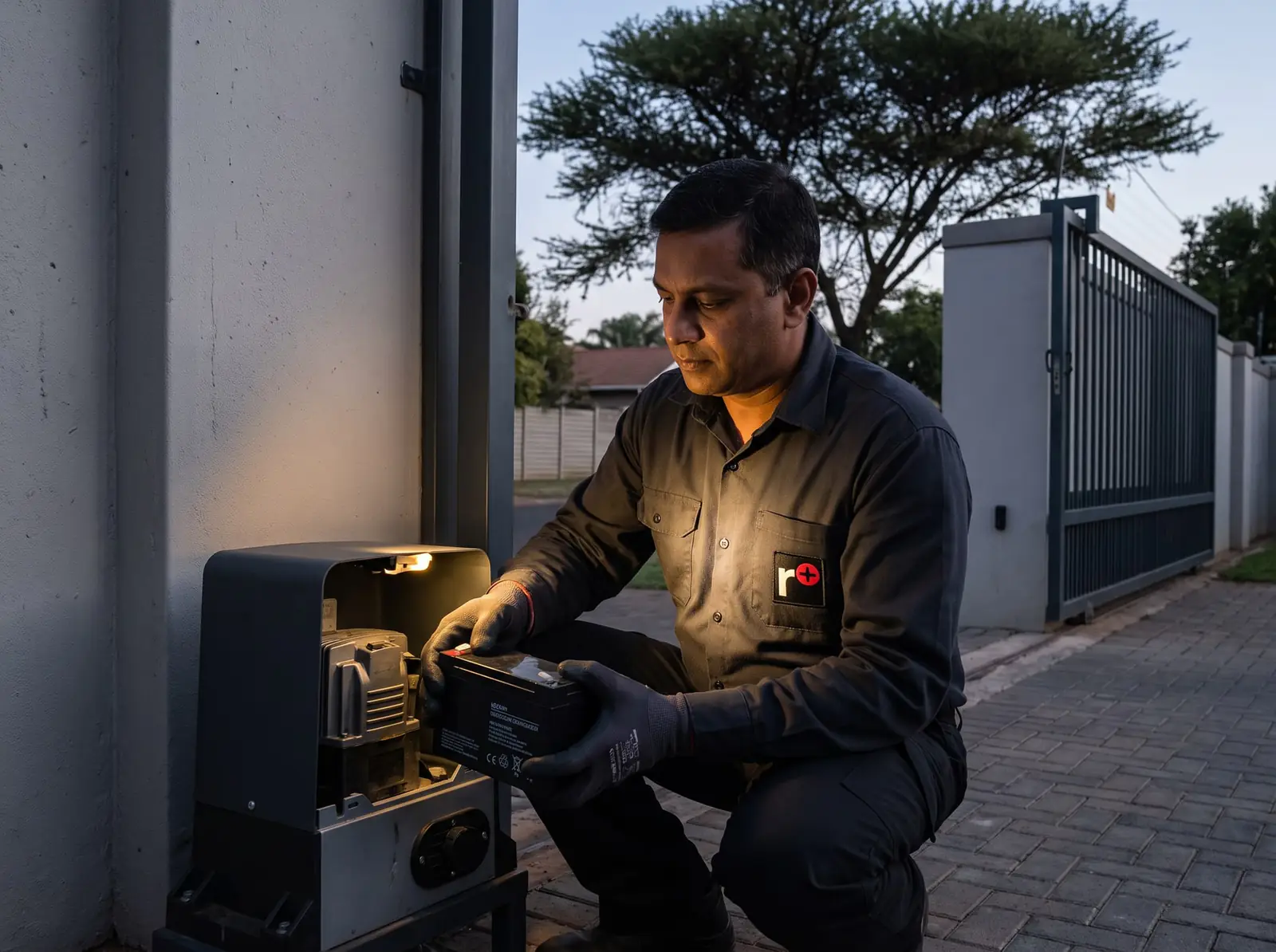
Solar charging: the makers' figures
On a solar setup, a panel charges the battery through a solar regulator, which takes the place of the mains charger or works beside it. The makers give these starting points:
| Motor | Panel | Battery |
|---|---|---|
| Centurion D5-Evo | 20 W: enough for about 20 operations of an average gate a day | Deep-cycle, at least 35 Ah, with a high-efficiency solar regulator replacing the standard charger |
| Centurion D10, D10 Turbo | Typically two 20 W panels in series | The 24 V battery supply |
| Centurion D-series SMART, 12 V | 20 W to 150 W, 18 V output, through a solar regulator | 33 Ah to 200 Ah |
| Centurion 24 V SMART models | One 80 W, 36 V panel, or two 18 V panels | Two batteries, 33 Ah to 200 Ah |
| Gemini 12 V DC slider | Through its solar adaptor board, alongside the mains | The motor's battery, charged from either |
Centurion stresses that these are typical values for Southern Africa: the right panel depends on where you are, how often the gate runs, and what else the battery feeds. 12 V DC security lights on the same battery cut the number of openings, and a run of cloudy days is what the bigger battery is for. Gemini also lists its DC sliders as solar and lithium compatible.
No mains at the gate
Gates at the end of a long driveway, on a smallholding or at a property where no cable was ever run, are where solar earns its place. A panel and a correctly sized battery run the motor with no mains at all.
Centurion also offers a middle way for its D5-Evo: the Low-Voltage model. Instead of a mains charger at the gate, it takes 15 to 19 V AC from a plug-in step-down transformer, usually in the house, so no high-voltage cable has to be run to the gate and no electrical certificate is needed for it. Where a new mains supply to the gate is the better answer, that's a job for a registered electrician.
Running the gate off the house's inverter or UPS
If your home already has an inverter or a UPS, the gate can share it. The motor's charger is an ordinary mains charger, plugged into a socket or wired to an isolator near the gate. Centurion's CP84SM, for example, accepts 110 to 265 V AC and puts out 14.3 V DC at about 1.5 to 1.7 A to keep the battery topped up. If the circuit feeding that charger is one of the circuits your inverter backs up, the charger carries on through load shedding and the gate's battery stays charged.
Two things to know:
- The gate's circuit may not be on the backed-up side. Inverter installations don't always back up every circuit. Moving the gate's supply onto a backed-up circuit is a job for a registered electrician.
- Keep the motor's own battery healthy anyway. It's what runs the gate if the inverter trips or its batteries run down.
Protecting the battery in long outages
When a motor's battery runs low, the motor stops, but not everything else does. Centurion's manual points out that after a low-battery shutdown on a D5-Evo or D10, the controller, the safety beams and anything else connected keep drawing current, flattening the battery further, only more slowly. A battery drained right down can be damaged for good.
For the D5-Evo, Centurion offers an optional low cut-out switch that disconnects the battery completely before that happens. In a run of long outages, that spares the battery the deep discharge that can ruin it. For what the motor does once the power returns, see gate motor after load shedding.
Solar gate repairs: when a solar gate stops working
A solar-powered gate that keeps running flat usually has one of these:
- A panel that isn't charging: dirty, shaded by a tree that has grown, knocked off its angle, or with a damaged cable.
- A regulator that has failed, so the panel's charge never reaches the battery.
- A worn or undersized battery that can't carry the gate through the night or a cloudy spell.
- More use than the panel can replace: a gate that now runs far more often, or lights and accessories added to the same battery.
- Corroded connections at the battery, the regulator or the panel.
What you can safely do is keep the panel clean and clear of shade, and note when the gate gives up: after cloudy days, in the evenings, or all the time. We test the panel's output, the regulator and the battery, and resize the system where the gate's use has outgrown it. The areas we cover are on areas.
Getting it set up or fixed
Tell us the motor's make and model, roughly how often the gate runs, and whether there's mains at the gate. We'll recommend a battery, solar or inverter-fed setup that suits it, fit it, and fix the ones that have stopped working. All our spare parts are genuine, and every repair carries our six-month guarantee on our repairs. Your exact price is set in a free quote before any work starts. No call-out fee when we do the work. If no work is done, a R650 call-out fee applies.
Questions
Solar and backup power questions
How much does a solar gate opener cost?
It depends on the panel and battery the gate needs, which depend on how often it runs and where it is: a D5-Evo, for example, needs a 20 W panel and a battery of at least 35 Ah for about 20 operations a day. We quote after seeing the gate. See the makers' figures.
How much power does a gate motor use?
Very little from the mains: the motor runs from its battery, and the charger only tops it up. Centurion's CP84SM charger, for example, puts out 14.3 V DC at about 1.5 to 1.7 A. That's why a modest solar panel can do the same job. See running it off an inverter.
Book a technician
Get a gate motor quote
Job card
We WhatsApp or call you back. Fields marked (required) are needed.