Manual · Digidoor Digi 6
Digi 6 garage door motor: manual, remotes and fault letters
The Digi 6 is Hydro Doors' ceiling-mounted opener for sectional and tip-up doors, running a chain or a belt along a steel rail. It's quiet, needs very little headroom and is set from four buttons beside a one-digit display. Here's what it can lift, how to set it up and code remotes, how to look after it, and what the letters on its display mean when something's wrong, from Hydro Doors' own guide.
Six-month guarantee on our repairs
What the Digi 6 can lift
| Item | Digi 6 |
|---|---|
| Pulling force | 600 N |
| Largest door | 12 m², up to 180 kg when balanced |
| Door height | 2.4 to 3.5 m |
| Drive | Chain or belt on a steel C-rail |
| Speed | 160 mm a second |
| Remotes | Rolling code on 433.92 MHz; 2 supplied, up to 20 stored |
| Light | 24 V LED, 15 lamps, switching off after 3 minutes |
| Limits | Electronic |
| Working temperature | −40 °C to 50 °C |
| Protection | Soft start and stop, overload protection on the transformer; IP20, so it belongs indoors |
The 180 kg is for a balanced door: the springs carry the weight and the opener only moves it.
Features worth knowing about
- Low headroom. It needs as little as 30 mm between the ceiling and the highest point the door reaches, so it can be mounted flush in a low garage.
- Self-learning force. It learns how much effort each part of the door's travel needs during setup, and keeps re-profiling as it runs, which is how it senses an obstruction.
- Self-locking gearbox. With the opener engaged, the door can't simply be pushed up from outside.
- Up and Down buttons on the back of the power head, handy when setting up or testing.
- Terminals for safety beams, extra receivers, a wired or wireless wall switch and a caution light.
- Optional battery backup, fixed to the top or the side of the opener, plugged into its own cable.
Before a Digi 6 goes in
Hydro Doors' rules for a good installation:
- The door must lift and close easily by hand. The opener can't make up for a badly installed or badly sprung door, and it isn't a cure for a problem door.
- Old locks and latches on the door are removed or disabled.
- An approved plug point is fitted close to the opener; that's a job for a registered electrician.
- There's at least 30 mm between the bottom of the rail and the top of the door where they come closest.
- The wall bracket goes on the inside wall on the door's centre line, between 20 and 150 mm above the door, and the door bracket on a solid part of the top panel, level with the top rollers.
Hydro Doors also strongly recommends safety beams on every installation, on top of the opener's own obstruction sensing.
Setting the open and closed positions
- Hold SET until 1 shows, and let go. The opener is in programming mode.
- Hold UP until the door reaches the open position you want. Fine-tune with UP and DOWN.
- Press SET to confirm. The display shows 2.
- Hold DOWN until the door reaches the closed position. Fine-tune with UP and DOWN.
- Press SET to confirm. The door now opens and closes on its own to learn its travel and the force it needs, and is then ready to use.
If the display shows O while it's learning, the travel is under 30 cm or over 9 m, and the positions have to be set again.
Coding and deleting Digi 6 remotes
The two remotes that come with a Digi 6 are already coded. For any others:
- Press CODE. A dot appears at the bottom right of the display.
- Press the button you want on the remote, wait 2 seconds, then press the same button again for another 2 seconds.
- The dot flashes and goes out: that remote works. Repeat for each extra remote.
The opener stores 20. To delete every remote, hold CODE until C shows. There's no way to remove just one, so after a lost remote, delete them all and recode the ones you have.
Obstruction force
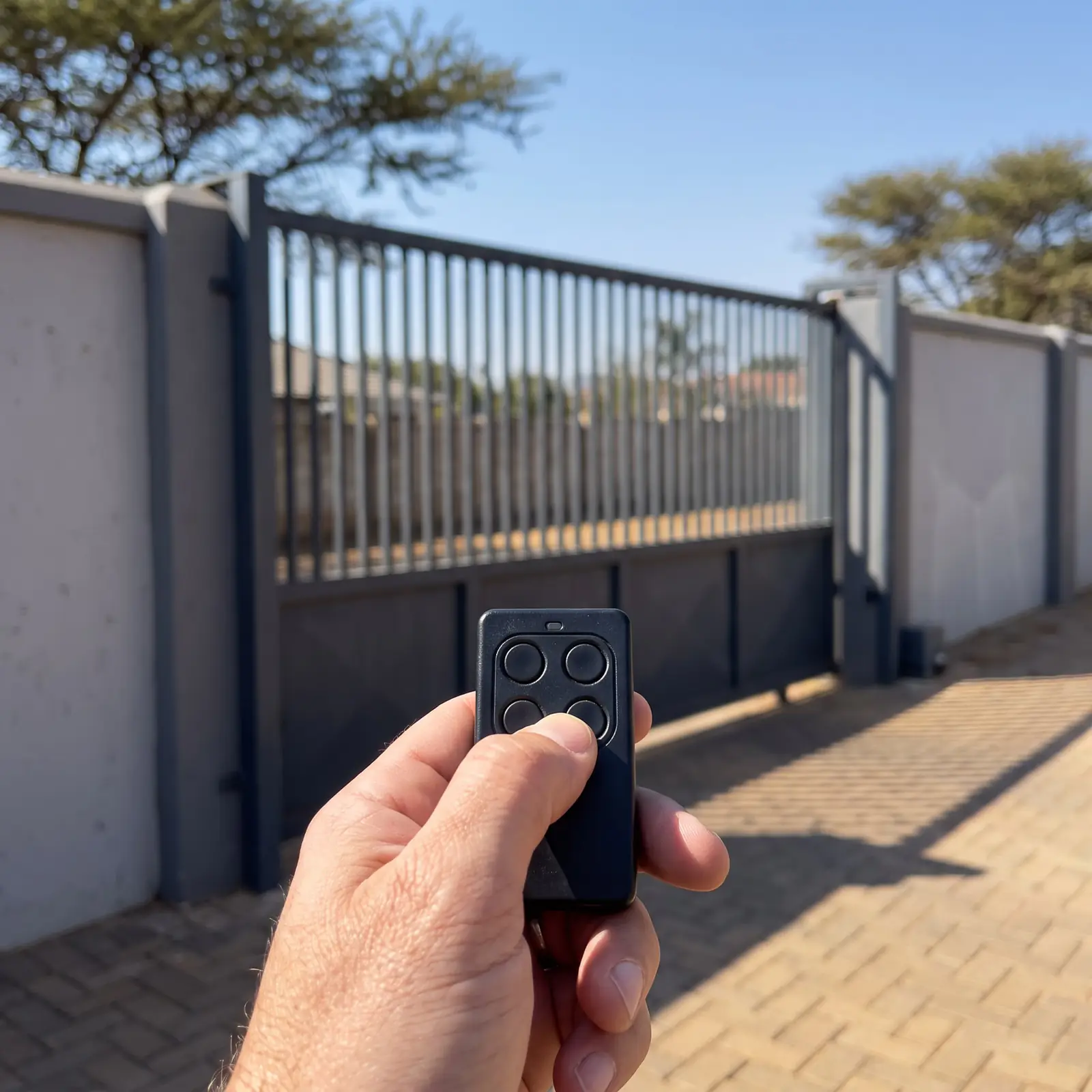
The force is set automatically during setup, and Hydro Doors says it normally needs no change. If it does, hold SET until 3 shows, then UP to increase or DOWN to decrease. The lowest setting is 1; the factory setting is 3. SET confirms.
Check it once a month the way the guide asks: put an object 50 mm high on the floor under the door and close it. The door must reverse when it touches it. The guide is careful to say the obstruction system is designed for stationary objects, so never rely on it to stop for a moving person or car: that's what safety beams are for.
Digi 6 fault letters and what to do
| What you see | Cause | What it needs |
|---|---|---|
| Dead, or a dim display | No power, a loose plug, a blown fuse, the transformer or the control board | Check the plug point and fuse; the rest is a technician's job |
| Limits lost | A system error | Set the open and closed positions again |
| O while learning | Travel under 30 cm or over 9 m | Set the positions again |
| P, and it won't run or stops | Not enough voltage | Check the power supply |
| L or b | The door's springs are out of balance | Have the springs balanced |
| - and it won't run | Limits not learnt, or learnt wrongly | Set the positions again |
| Courtesy LEDs never go off | A faulty control or power board | Board replacement |
| Stops after about 10 cm and shows H | Loose or damaged Hall sensor wire | Inside the cover: a technician's job |
| Relay clicks, won't run, shows H | Loose wires between motor and board | Inside the cover: a technician's job |
Battery faults show up as a door that won't run in a power cut: the battery, its wires or the charger. If odd behaviour starts after something was added to the opener, Hydro Doors' advice is to disconnect the extra devices first.
Releasing the door, and looking after it
To move the door by hand, pull the release handle down to free the shuttle, and keep holding it while you move the door. To reconnect, run the opener, or move the door by hand until the trolley locks into the chain's shuttle again. Be careful releasing an open door: weak or broken springs can let it drop fast. If the garage door is the only way into the garage, fit an outside key release.
Looking after it, from the guide: the control board needs no maintenance, but check the door's balance and parts at least twice a year, check the obstruction sensing twice a year, and make sure the beams work. A door that runs badly shortens the opener's life.
When to call us, and the PDF
Call us when the Digi 6 shows H, L or b, when its lights stay on, when it won't learn its positions, or when the door feels heavy by hand. We repair Digi 6 power heads, boards, transformers, chains, belts and trolleys, balance the door's springs, and fit batteries and beams. All our spare parts are genuine where the parts are still made, and every repair carries our six-month guarantee on our repairs.
A digidoor opener with battery back-up sells for about R4 580 (Takealot) in shops (Prices checked October 2026). Your exact price is set in a free quote before any work starts. No call-out fee when we do the work. If no work is done, a R650 call-out fee applies.
The official PDF: Digidoor Digi 6 garage door motor, installer manual. All the Digidoor openers are compared on the Digidoor manual.
Questions
Digi 6 questions
How heavy a door can a Digi 6 open?
Hydro Doors gives up to 12 m² and 180 kg for a balanced door, 2.4 to 3.5 m high, with 600 N of pulling force. The springs must carry the door's weight. See the specifications.
How do I add a remote to a Digi 6?
Press CODE until a dot shows at the bottom right, press the remote button, wait 2 seconds, then press it again for 2 seconds; the dot flashes to confirm. See coding remotes.
What does H mean on a Digi 6?
H points to wiring inside the opener: a loose or damaged Hall sensor wire if it stops after about 10 cm, or loose motor wires if the relay clicks and nothing moves. Both are technician jobs. See the fault letters.
Why does my Digi 6 show L?
L or b means the door's springs are out of balance, so the opener is carrying weight it shouldn't. The springs need balancing by a technician. See the fault letters.
Book a technician
Get a garage door quote
Job card
We WhatsApp or call you back. Fields marked (required) are needed.