Guides · Electric fencing
Electric fence low voltage: why it drops and how it's fixed
An electric fence is only a deterrent while it carries a strong pulse. When the voltage drops, the energizer shows a check or bad reading, flashes a warning light, and may alarm, and the fence becomes easier to cross. Low voltage is almost always a leak: somewhere along the line, the pulse is escaping to earth. Here's how to read it, where it usually leaks, and what's safe for you to do.
2-year warranty and a compliance certificate on every new electric fence we install
How much voltage a fence needs
JVA's installer manual gives a clear bar: to be an effective barrier, the reading between the wires, live to earth, should be more than 5.0 kV everywhere along the fence. Below that, JVA's advice is that the energizer may be too small for the fence. Most security energizers put out far more than that with no load; what reaches the far end of the fence is what counts.
Your energizer shows the state in its own way: GOOD, CHECK or BAD on a Nemtek Druid, a fence light flashing green or red on a JVA, or a slowly flashing fence check light on a Nemtek Merlin. Some show the actual figures: on a Druid keypad, 6 1 # shows the voltage going out and coming back, and 6 3 # the percentage lost along the fence.
Why the voltage drops
In rough order of how often we find them:
- Plants touching the wires. Grass, creepers and branches bleed the pulse to earth, worst when wet.
- Dirty, cracked or failed insulators. Nemtek's manuals name damaged and wet insulators, and salt build-up at the coast, as things that stop a fence holding a high voltage. Snails, slugs and spiders on insulators do the same.
- A wire touching an earth wire or the wall, or a bracket that has bent.
- A broken or badly joined wire, which can also leave the far end of the fence with almost nothing.
- A poor earth. The pulse needs a good return path; dry ground, corroded spikes or a cut earth wire weaken the whole fence.
- A fence that's grown too big for the energizer, after an extension or more strands were added.
- The energizer itself, usually its battery after load shedding, or a fault after a storm.
Low only in rain or at night?
If the voltage drops in rain, early in the morning with dew, or at night, the cause is almost always plants and insulators: water turns a small leak into a big one, and snails come out at night. Nemtek's Druid deals with this better than most: when wet or dirty insulators start to arc, it runs the fence just below the voltage where arcing begins, instead of pushing all its energy through the leak. But it can't fix the leak.
JVA's manual also covers the other side: a properly set-up monitor shouldn't alarm on dew, rain, grass or spider webs. If yours does, the alarm level may need adjusting by the installer, but only after the fence itself has been cleaned up.
Safe checks you can do
- Read the energizer or keypad, and write down the figures or lights.
- Walk the fence line at a safe distance, looking for plants touching the wires, broken or sagging strands, bent brackets, and insulators that are cracked, blackened or covered in snails.
- Have plants cut back with the fence switched off by the master user, and keep the cuttings well clear.
- Switch the fence back on and compare the reading.
- Note the pattern: all the time, or only when wet, or only in one zone.
Never touch the wires or try to clear them with the fence on, and don't climb up to reach a wall-top fence. JVA's advice for anyone working on a fence is to switch the energizer off first.
How a technician finds the short
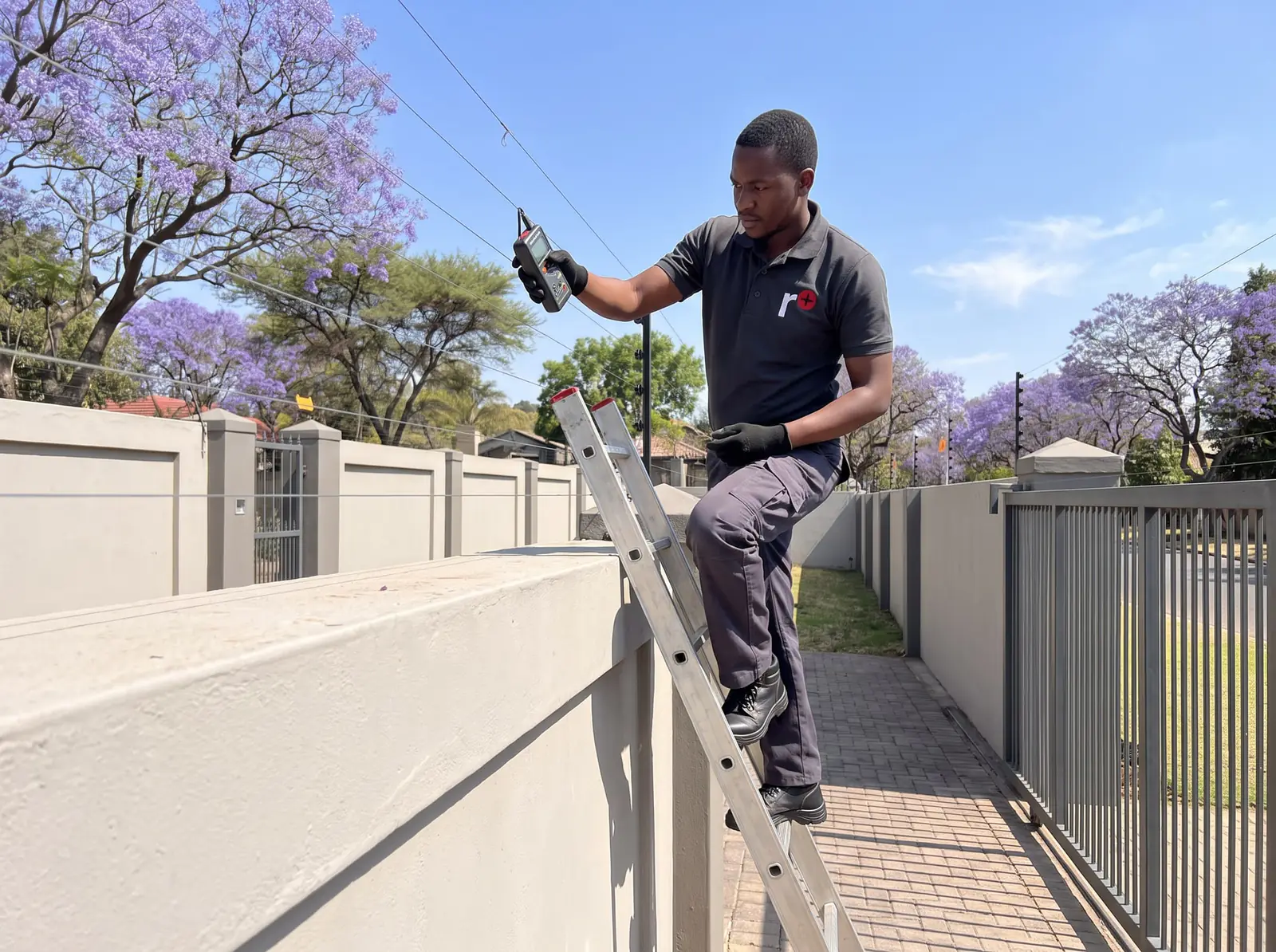
Finding a leak you can't see is methodical work with an electric fence voltmeter or power probe:
- Measure the voltage at the start and end of the live wires, as JVA's commissioning tests describe, to see how much is being lost along the way.
- Test each strand and section, working along the fence, to find where the voltage falls away.
- Check the earth, by measuring the voltage on the earth system when a deliberate short is made: JVA expects it to stay below a few hundred volts.
- Test the alarm both ways: a break and a short on the fence should each set off the alarm.
Once the leak is found, the fix is usually an insulator, a joint, a wire or the earth spikes. If the fence has outgrown the energizer, a stronger one, or splitting the fence into zones, sorts it out.
Typical repair costs
Typical figures in the market:
- Simple repairs (insulators, a broken wire) including call-out: R700–R1 400 (Kandua)
- Energiser repair: R800–R2 500 (Kandua)
These are the market's figures, not ours. Prices checked October 2026. Every repair carries our six-month guarantee on our repairs. Your exact price is set in a free quote before any work starts. No call-out fee when we do the work. If no work is done, a R650 call-out fee applies.
Questions
Questions about low fence voltage
What should I do if my electric fence has low voltage?
Read the energizer, then walk the fence at a safe distance looking for plants, broken wires and dirty or cracked insulators; have the plants cut back with the fence off and compare the reading. If it stays low, a technician finds the leak with a voltmeter. See the safe checks.
How to find short circuit in electric fence?
With an electric fence voltmeter or power probe, measuring each strand and section until the voltage falls away, then checking the earth. It's done with the energizer's power on the fence, so it's a technician's job. See how shorts are found.
What voltage should an electric fence have?
JVA's guideline for an effective security fence is more than 5.0 kV between the wires, live to earth, everywhere along the fence; less suggests a leak or an energizer too small for the fence. See how much voltage a fence needs.
Book a technician
Get an electric fence quote
Job card
We WhatsApp or call you back. Fields marked (required) are needed.